

Free Speech T-Shirt: Wear Your Rights

Table of Contents
- What a Free Speech T-Shirt Really Means
- First Amendment Apparel: Your Constitutional Right to Wear Political Messages
- Legal Rights Regarding Political Clothing: What You Can Wear and Where
- How to Choose Durable Protest Apparel That Survives the Marches
- The History of Political Fashion as Resistance
- Styling Your Free Speech T-Shirt for Impact
- Care Instructions to Keep Your Message Visible
- Frequently Asked Questions
Last Updated: August 31, 2026
What a Free Speech T-Shirt Really Means
A free speech t-shirt is wearable political expression, a garment printed with a message that communicates your stance on democracy, rights, or resistance to authoritarianism. Unlike generic merchandise, it serves a purpose: it turns your body into a statement that travels with you to marches, workplaces, and everyday streets.
The First Amendment protects your right to wear political messages. But protection doesn't mean consequence-free. Your employer might object. A school might restrict it. Understanding what you can legally wear, where, and how to make sure your message survives repeated washing is the difference between a gesture that lasts and one that fades.
At DOCVCARE THINK NOW protest apparel, we've built our business around this principle: the message matters more than the merchandise. Every tee, hoodie, and cap carries an original slogan design for people who are angry, organized, and ready to show it. Garments are printed on premium blanks, Gildan, Champion, Bella+Canvas, so your message doesn't crack or fade after the first march or the hundredth wash. This guide covers what a free speech t-shirt is, your constitutional rights when wearing one, how to choose apparel that survives real-world activism, and how to care for your statement piece so it stays visible for years.
First Amendment Apparel: Your Constitutional Right to Wear Political Messages
The First Amendment protects freedom of expression, including political clothing. In 1969, the Supreme Court ruled in Tinker v. Des Moines Independent Community School District that students wearing black armbands to protest the Vietnam War were engaged in protected symbolic speech (supremecourt.gov). The Court stated that students do not "shed their constitutional rights at the schoolhouse gate." That principle applies beyond schools: wearing a political t-shirt is recognized as constitutionally protected expression.
In practice, you have the legal right to wear a free speech t-shirt that expresses your political views, criticizes the government, or communicates resistance to policies you oppose. The government cannot arrest you, fine you, or prosecute you simply for wearing political apparel in public spaces.
The catch is that First Amendment protection applies to government action, not private consequences. Your employer can restrict what you wear at work. A private business can ask you to leave. Your school might have dress codes. The First Amendment shields you from government censorship, not from social disapproval or employment decisions based on your visible politics.
Understanding your specific situation matters. A free speech t-shirt worn to a public march is maximally protected. The same shirt worn to a corporate office where political expression is banned might cost you your job. Knowing the difference helps you make informed choices about when and where to wear your message.
The First Amendment protections for symbolic speech
Legal Rights Regarding Political Clothing: What You Can Wear and Where
Your legal right to wear political clothing depends on where you are and who controls the space. Public spaces offer the strongest protection. Private spaces offer less.
Schools and Political Speech
Public schools are government institutions, so the First Amendment applies. Students have the right to wear political clothing unless it materially disrupts school operations or violates established, content-neutral dress codes. The Tinker standard requires that school officials prove the speech would cause substantial disruption before restricting it. Simply being controversial is not enough.
A student can wear a free speech t-shirt at a public school if the shirt doesn't incite violence, isn't sexually explicit, and doesn't promote illegal activity. A shirt criticizing the government or expressing anti-authoritarian views is protected.
Private schools have more discretion and can enforce stricter dress codes because they are not bound by the First Amendment. Public universities must respect student First Amendment rights. Private universities have more flexibility but often have institutional commitments to free expression that limit their ability to censor student speech through dress codes.
Workplaces and Employer Restrictions
Your employer can restrict what you wear at work, including political clothing. Most workplaces have dress codes, and employers can enforce them.
However, some protections exist. Title VII of the Civil Rights Act prohibits discrimination based on race, color, religion, sex, or national origin (eeoc.gov). If an employer allows some employees to wear religious apparel but not others, or allows some political messages but not others based on protected characteristics, that differential enforcement may violate civil rights law. Union organizing is also protected under labor law, though protections vary by state and industry.
For marches, protests, and public events, your legal protections are strongest. You can wear a free speech t-shirt to a march, a public square, or any government-controlled public space. The government cannot restrict you based on the political content of your message.
How to Choose Durable Protest Apparel That Survives the Marches
A free speech t-shirt is useless if the print cracks after three washes or fades after two months. When choosing apparel for activism, durability matters. You're buying a tool that needs to survive repeated use, weather, and washing.
Fabric Quality and Weight Matter
The blank determines how long your message lasts. Cheap, thin cotton deteriorates quickly. A quality protest tee should be at least 5 ounces per square yard of fabric weight. Ring-spun cotton, which is combed and twisted for strength, lasts longer than standard cotton.
DOCVCARE THINK NOW protest apparel uses premium blanks from Gildan, Champion, and Bella+Canvas specifically because these manufacturers produce consistent, durable fabric. The Unisex Garment-Dyed Heavyweight T-Shirt is built for activists who wear their shirts repeatedly. The heavyweight construction means the shirt improves with age rather than degrading.

Poly-blend fabrics (cotton mixed with polyester) offer advantages for activism. Polyester adds durability and shape retention. A 90/10 cotton-polyester blend resists wrinkles, maintains its fit through repeated washing, and holds color better than 100% cotton.
Print Quality and Longevity
Screen printing uses thick ink applied directly to the fabric. High-quality screen printing uses multiple layers and proper curing, making the print durable and resistant to cracking. Direct-to-garment printing (DTG) applies ink using inkjet technology, but the ink sits on top of the fabric rather than bonding with it, making it more vulnerable to fading and cracking.
For activism, screen printing is the better choice. When you buy a free speech t-shirt, ask about the print method. Dark inks (black, navy, dark red) are more durable than light inks. White ink on dark fabric is prone to yellowing and cracking.
Shop the resistance collection →
The History of Political Fashion as Resistance
Political expression through clothing has deep roots in protest movements. From labor organizing to modern civil rights marches, what people wear signals their commitment and solidarity.
During the labor movement of the early 20th century, workers wore armbands, buttons, and ribbons to identify themselves as union members and signal their collective power. Wearing union insignia could cost you your job. People wore them anyway because visibility mattered.
The civil rights movement of the 1960s made clothing into a deliberate statement. Protesters wore formal attire to counter stereotypes. Later, Black Power advocates wore dashikis and natural hair as explicit rejection of assimilationist aesthetics. The clothing choice was political.
Anti-war protesters in the 1960s and 1970s wore tie-dye and symbols of peace. The visual distinction from mainstream America was intentional. Your appearance announced your refusal to comply with the status quo.
The AIDS crisis created ACT UP and the iconic slogan "Silence = Death" printed on black t-shirts. The simplicity and boldness of that design became iconic because it was worn to marches, funerals, and public spaces. The shirt made invisible suffering visible.
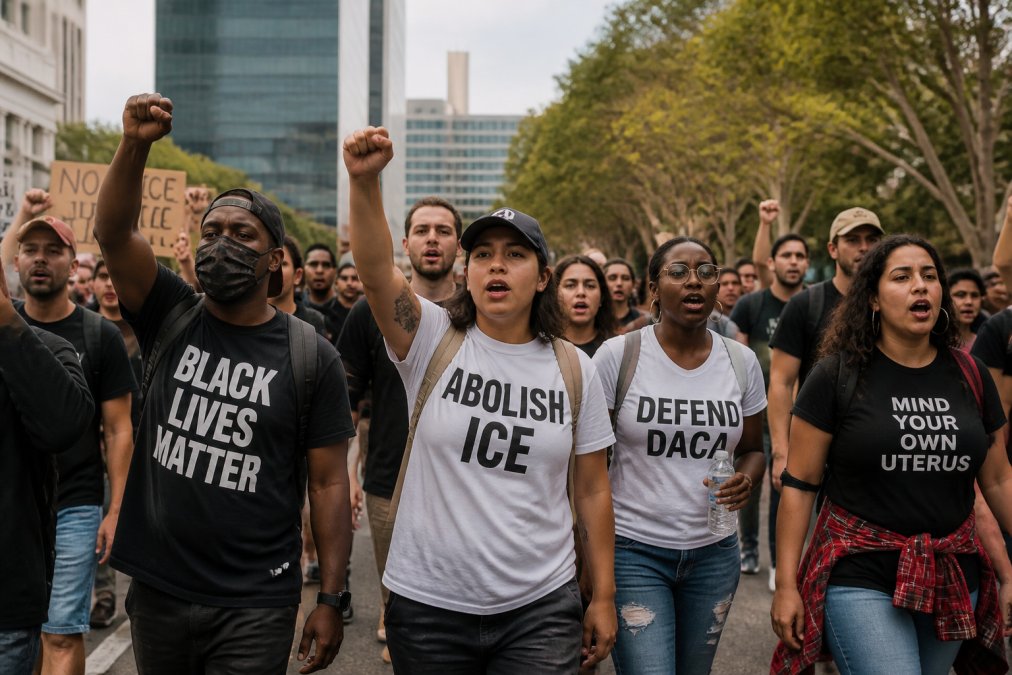
Today's protest apparel continues this tradition. A free speech t-shirt isn't a fashion statement. It's a deliberate act of visibility. When you wear a shirt that communicates resistance, you're participating in a lineage of activists who used clothing to say what words alone could not. You're making yourself visible to others who share your politics. You're refusing to be silent.
Authoritarian movements understand this. They know that visible dissent is harder to ignore than private dissent. They know that people wearing political shirts create visual evidence of opposition. That's why they target activists' clothing, why they try to suppress visible resistance. Wearing a political t-shirt is an act of defiance precisely because it refuses that invisibility.
Styling Your Free Speech T-Shirt for Impact
How you wear a free speech t-shirt determines how your message lands. For maximum impact at a march or public event, wear your shirt as the focal point. Pair it with simple bottoms, dark jeans or black pants, that don't compete for attention. A well-fitted unisex tee sits cleanly on the body and makes the message readable from a distance.
For visibility in crowds, consider color contrast. A dark shirt with light text or a light shirt with dark text reads clearly from a distance. Neon or bright colors increase visibility in outdoor settings.
For layered looks, wear your free speech t-shirt as the base layer with a jacket or hoodie over it. Unbutton or unzip the jacket when you want the message visible. This approach works for workplaces where you need flexibility or for situations where you want to control when your message is on display.
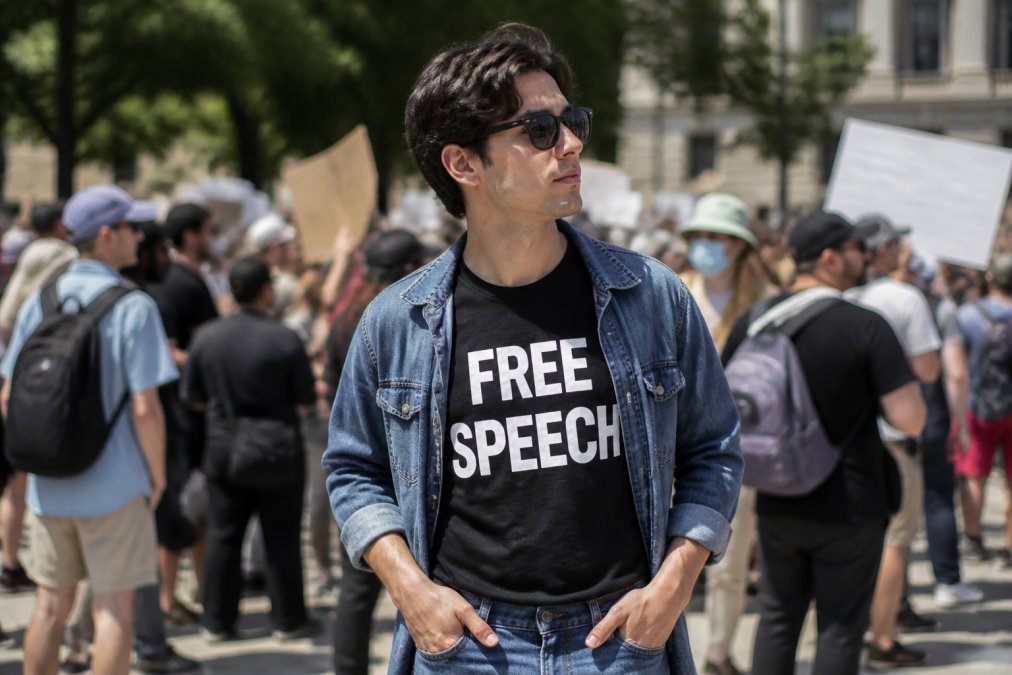
Fit matters more than most people realize. An oversized shirt reads as sloppy. A too-tight shirt looks uncomfortable and distracts from the message. A well-fitted unisex tee presents your message cleanly. DOCVCARE THINK NOW protest apparel designs with unisex fits specifically because activists come in all sizes and the message should be equally visible regardless of body type.
Care Instructions to Keep Your Message Visible
A free speech t-shirt is an investment. Proper care extends its life and keeps your message readable.
Wash in cold water. Hot water fades color and weakens fabric fibers. Turn the shirt inside out before washing to protect the printed side from friction. Use mild, dye-safe detergent and avoid bleach entirely.
Wash with similar colors to prevent dye bleeding. Air dry whenever possible. Machine drying applies heat that fades color and weakens fabric. Hang your shirt to dry in indirect sunlight. If you must use a dryer, use the lowest heat setting.
Iron on low heat, inside out, or avoid ironing altogether. Store in a cool, dry place away from direct sunlight. A well-made screen print should survive 50+ cold-water washes.
A free speech t-shirt is more than clothing. It's a tool for visibility, a statement of commitment, and a piece of activist infrastructure. When you wear one to a march, to work, to the street, you're participating in a long history of political resistance through fashion. You're making yourself visible to allies and refusing the invisibility that authoritarianism demands.
The shirt only works if it lasts. That's why DOCVCARE THINK NOW protest apparel builds on premium blanks and uses screen printing that survives repeated washing and real-world use. The message matters. The durability ensures it stays visible. When you're ready to wear your resistance, shop the collection, choose a shirt built to outlast the moment, and show up.
Frequently Asked Questions
Q: Is wearing a free speech t-shirt actually protected by the First Amendment?
A: Yes. The First Amendment protects your right to wear political messages on clothing. In Texas v. Johnson (1989), the Supreme Court ruled that symbolic speech, including wearing expressive apparel, receives constitutional protection. Schools and employers cannot ban political t-shirts simply because they disagree with the message, though narrow restrictions exist (like preventing disruption in schools or maintaining professional dress codes unrelated to the message itself).
Q: How do I choose durable protest apparel that won't fade or crack after multiple wears?
A: Look for heavyweight cotton or premium cotton blends (ring-spun cotton lasts longer), screen-printed designs using quality ink, and reinforced stitching on seams and hems. The Unisex Garment-Dyed Heavyweight T-Shirt ($40) uses durable heavyweight fabric that improves with wear. Avoid thin fabrics and cheap printing, your message deserves apparel that survives marches, washing, and storage without cracking or fading.
Q: Can my employer or school prevent me from wearing a political t-shirt?
A: It depends on context. Public schools cannot restrict political speech on t-shirts unless the message would cause substantial disruption (Tinker v. Des Moines, 1969). Private employers have broader authority to enforce dress codes, but they cannot target you solely for the political viewpoint. If other employees wear graphic tees, your political message gets the same protection. Always know your institution's actual policy before wearing something to work or school.
Q: What makes a free speech t-shirt a statement piece versus just a regular tee?
A: A free speech t-shirt carries an original slogan or design that expresses a political belief or calls for action. It's not just decoration, it's a wearable declaration of your values. Designs like 'REMOVE THE REGIME' on premium blanks signal your commitment to pro-democracy principles while you move through your day. The message is the point; the quality fabric ensures it survives long enough to be seen and read.
This article was written using GrandRanker