

Good Trouble Shirt: Wear Your Resistance

Table of Contents
- What Good Trouble Means: The John Lewis Good Trouble Quote
- Why a Good Trouble Shirt Matters
- Pro-Democracy Protest Apparel: More Than a T-Shirt
- Choosing the Right Good Trouble Shirt for Your Activism
- Activist Fashion Trends: Statement Wear for 2026
- Care Instructions to Keep Your Message Visible
- Building Your Resistance Wardrobe
- Frequently Asked Questions
Last Updated: September 3, 2026
What Good Trouble Means: The John Lewis Good Trouble Quote
The phrase "good trouble" comes from the late Congressman John Lewis, a civil rights icon who spent his life fighting for democracy and human dignity. In his final message to the world, published days before his death in 2020, Lewis wrote: "Do not get lost in a sea of despair. Be hopeful, be encouraged. We must accept finite disappointment, but we must never lose infinite hope. Ours is a future history that we are now to write, and by the choices we make now it will be determined (loc.gov)."
But the phrase that stuck was simpler and more direct: "good trouble." Lewis wasn't calling for quiet compliance or polite disagreement. He was calling for necessary trouble, the kind that disrupts injustice and forces systems to reckon with their own contradictions.
The Roots of Good Trouble in Civil Disobedience
The concept draws from a long tradition of principled civil disobedience articulated by Henry David Thoreau, Mahatma Gandhi, and Dr. Martin Luther King Jr. King wrote extensively about the distinction between just and unjust laws, and the moral obligation to break unjust ones through nonviolent resistance (peer-reviewed research). The civil rights movement operationalized this through sit-ins, Freedom Rides, and marches that deliberately violated segregation laws (loc.gov). These actions were disruptive enough to force response, visible enough to demand attention, and disciplined enough to maintain moral authority. Participants trained in nonviolence, understood the legal consequences, and accepted them as part of the tactic. That's what separated "good trouble" from rioting, it was strategic, principled, and willing to absorb state violence without returning it.
Good Trouble vs. Silence vs. Violence
The phrase "good trouble" explicitly rejects three false choices: silence, violence, or ineffectual politeness.
Silence is complicity. When systems of injustice operate unopposed, they normalize and entrench. Silence is only safe for people who benefit from the status status quo.
Violence is a dead end for democratic resistance. It gives authoritarian forces justification to escalate repression, alienates potential allies, and shifts moral ground from "this system is unjust" to "these people are dangerous."
Good trouble is the third path. It's organized, principled resistance that makes power uncomfortable without destroying people. It's public enough to demand attention, disciplined enough to maintain moral authority, and willing to accept consequences, arrest, legal fees, social ostracism, as the cost of forcing change.
What a Good Trouble Shirt Signals
A good trouble shirt carries that legacy. It's not decoration. It's a statement that you've chosen the side of equality, activism, and the defense of democratic institutions against authoritarian threats. When you wear it, you're signaling that you understand the difference between silence and action, between ineffectual gestures and strategic resistance. You're saying: I'm willing to be visible. I'm willing to be counted.
Why a Good Trouble Shirt Matters
Wearing a message matters more than people realize. When you put on a good trouble shirt at a march, you're signaling to others that they're not alone. You're making your politics visible in a way that text on a screen never can.
Democracy depends on people showing up in public spaces and saying clearly: we're here, we're organized, and we're not backing down. A good trouble shirt does that work. It's practical activism. It's solidarity made tangible.
DOCVCARE THINK NOW protest apparel understands this. Every shirt carries an original slogan design, not recycled marketplace clip art. The designs are built to last through marches, laundry cycles, and months of regular wear. The blanks are premium (Champion, Gildan, Bella+Canvas), which means the message survives the washing machine.
A shirt that fades after three washes isn't activism, it's a souvenir. You want something that holds up because you're going to wear it to every march, every protest, every moment when democracy needs a visible show of force.
Pro-Democracy Protest Apparel: More Than a T-Shirt
Protest apparel has a history. The civil rights movement wore specific colors and symbols. Anti-war activists in the 1960s and 70s used t-shirts as billboards. Queer liberation movements used fashion as defiance. Today's pro-democracy resistance is doing the same thing.
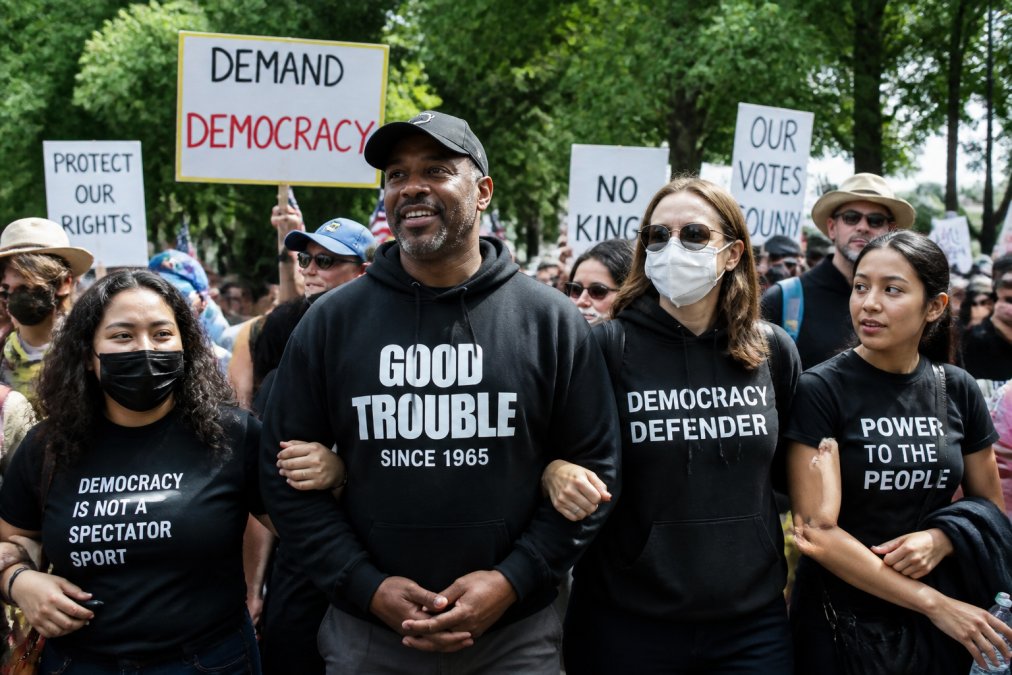
A good trouble shirt is a uniform of sorts. When you wear it, you're joining a visible movement. You're making a choice to be counted. That visibility matters in ways that private donations or online activism cannot match.
Original Designs, Not Marketplace Clip Art
Most protest apparel fails because drop-ship retailers source generic designs from massive marketplaces. You end up wearing something hundreds of other people are wearing from completely different makers. The design is weak because it was created for maximum broad appeal, not clarity or impact.
DOCVCARE THINK NOW does the opposite. Every design is original, created by the founder. They're not licensed from design aggregators or stock libraries. When you wear a DOCVCARE THINK NOW shirt, you're wearing something that exists nowhere else.
The designs are built for clarity. They work at protest scale, readable from twenty feet away. They work in photos. They work when you're packed shoulder-to-shoulder with thousands of other people marching for democracy.
Premium Blanks That Last Through the Marches
A cheap blank falls apart. The fabric thins, the print cracks, the collar stretches out. That's not acceptable for activist wear.
DOCVCARE THINK NOW uses premium blanks from manufacturers that know how to make apparel surviving real use. Champion hoodies with Double Dry moisture-wicking technology. Bella+Canvas tees with ring-spun cotton that softens with wear instead of breaking down. These hold up through fifty washes, not five.
Choosing the Right Good Trouble Shirt for Your Activism
Not every activist situation calls for the same apparel.
Fit and Sizing for Long Days
If you're wearing a shirt to a march lasting six hours, fit matters. An ill-fitting shirt will bunch, ride up, or create pressure points that become unbearable by hour four. You want something that moves with you, doesn't restrict your arms, and stays in place when pressed against other people.
Unisex sizing works well because it's designed to fit a range of body types without being too tight or too loose. The DOCVCARE THINK NOW premium hoodies and tees use relaxed, unisex fits that accommodate smaller and larger frames.
Fabric weight matters too. A midweight hoodie is warm enough for cool weather marches without overheating when you're moving and surrounded by thousands of people. A lightweight tee works for warmer days.

Fabric and Print Durability
Cotton-blend fabrics (typically 50/50 cotton and polyester) hold up better than 100% cotton because the polyester adds durability and reduces shrinkage. Ring-spun cotton is worth the premium, it's smoother, stronger, and softer than regular cotton, resists pilling, and maintains appearance longer.
The screen print process matters. A print applied with proper pressure and cured correctly will crack less and fade slower. When you buy from an independent maker like DOCVCARE THINK NOW instead of a mass-market retailer, you're getting direct contact with people who care about the quality of the final product.
Activist Fashion Trends: Statement Wear for 2026
The landscape of activist fashion has shifted significantly from the t-shirt-centric model of earlier decades.
Shop the resistance collection →
Why Hoodies Dominate Contemporary Activism
Hoodies have become the dominant form of activist wear for concrete reasons. They're visible from a distance, they provide a large canvas for designs, and they offer practical advantages that t-shirts don't. A hoodie keeps you warm during long outdoor actions without requiring you to carry a jacket. The hood provides weather protection. The front pocket gives you a place to carry keys or phone without needing a separate bag.
More importantly, hoodies signal commitment in a way that a casual t-shirt doesn't. A hoodie is a deliberate choice. It says you're prepared for a long day, that you're planning to be visible, that you're showing up.

Long sleeves have become standard for practical reasons. They protect your skin during long marches in direct sun. They provide a larger surface area for designs, making your message more readable from a distance. They're appropriate across more seasons and weather conditions, which matters for year-round activism.
Choosing Statement Wear for Specific Activism Contexts
For outdoor marches and rallies: A hoodie or long-sleeve tee is ideal. You'll be standing or walking for hours, possibly in variable weather. Choose a color with good contrast, black on white, white on black, or bold colors that stand out in crowds.
For workplace or casual visibility: A long-sleeve tee under a neutral jacket works better than a hoodie. It allows you to make your statement without appearing confrontational in professional spaces. You can remove the jacket if you're in a safe space, or keep it on if you need to navigate hostile environments.
For evening events or indoor gatherings: A short-sleeve tee or lightweight long-sleeve works. You don't need the bulk of a hoodie, but you still want the message visible.
For cold-weather activism: A hoodie is non-negotiable. Winter marches require warmth, and a hoodie provides it without restricting movement.
The Aesthetic Shift Toward Direct and Unapologetic
The design aesthetic has moved decisively away from cute, clever, or ironic toward direct and unapologetic. Cute slogans feel safe to power and are easy to dismiss as performative. Direct slogans, clear statements about what you believe and what you're fighting for, are harder to ignore.
Your statement wear should prioritize clarity over cleverness. A slogan that requires explanation is a weak slogan. A design that's hard to read from twenty feet away is a weak design. The best activist apparel communicates instantly, even to people who disagree with you.
Independent Makers vs. Corporate Capitalization
The best activist apparel is still made by people who are part of the movement, not by corporations trying to capitalize on it. Independent makers, activist-run shops, and owner-operated businesses are where the real movement merchandise comes from. When you buy from a corporate retailer, you're funding a company that will abandon the cause the moment it stops being profitable. When you buy from an independent maker, you're funding someone invested in the movement itself.
Care Instructions to Keep Your Message Visible
A good trouble shirt is only useful if it stays visible.
Wash in cold water. Hot water accelerates fading and can cause shrinkage. Turn the shirt inside out before washing to protect the print from friction with other garments. Use mild detergent, heavy-duty or bleach-containing detergents will fade the print and weaken the fabric faster.
Hang dry when possible instead of using a dryer. Machine drying generates heat and tumbling friction that damages both fabric and print. If you must use a dryer, use low heat and remove the shirt while still slightly damp.
Avoid chlorine bleach and oxygen bleach. These will fade the print and damage the fabric.
The print will fade slightly over time, that's inevitable with any screen-printed apparel. But with proper care, a DOCVCARE THINK NOW shirt will stay legible and wearable for years. You're not buying a disposable statement. You're buying something built to last as long as your commitment to democracy does.
Building Your Resistance Wardrobe
One good trouble shirt is a statement. A wardrobe is a practice.
Think about layering. A DOCVCARE THINK NOW hoodie works as a standalone piece, but it also works as a layer under a jacket for cooler weather. A long sleeve tee becomes a base layer under the hoodie. By building a small collection, you ensure you have something appropriate for any activism situation.
Consider the color. Black is bold and reads well from a distance. Heather grey is slightly less stark but still carries weight. White makes a statement in a different way, harder to ignore, more visible in photos.
Think about group coordination too. If you're organizing a chapter or group, having everyone in the same shirt creates visual unity. That's powerful at a march. DOCVCARE THINK NOW can handle group orders.
The work of democracy isn't just voting or donating. It's showing up. It's being visible. It's refusing to let authoritarianism become normal through silence.
A good trouble shirt is part of that work. It's a tool for resistance that you can wear to work, to the grocery store, to every space where people need to know that democracy still has defenders. DOCVCARE THINK NOW protest apparel builds shirts designed for that purpose, original designs on premium blanks that survive real use. When you're ready to make your resistance visible, that's where you start. Shop the resistance collection and wear it like you mean it.
Frequently Asked Questions
Q: What does the phrase 'good trouble' mean, and where did it come from?
A: The phrase 'good trouble' comes from civil rights leader John Lewis, who called it necessary trouble, the kind caused by standing up for justice and equality. Lewis used this language to describe nonviolent protest, civil disobedience, and the work of activism. Wearing a good trouble shirt signals that you understand activism as moral work, not disruption. It ties your clothing to a documented legacy of American civil rights struggle and places you in that lineage of resistance.
Q: Will the print on a good trouble shirt fade or crack after multiple washes?
A: Print durability depends on the blank quality and printing method. DOCVCARE THINK NOW uses premium Gildan, Champion, and Bella+Canvas blanks, which holds up through dozens of washes if you follow care instructions. Wash in cold water inside-out, avoid the dryer, and the print survives. Budget-apparel makers use thin blanks and cheap transfers that crack by wash three. If you're wearing your shirt to every march, invest in a premium blank, it's the difference between a message that lasts and one that doesn't.
Q: How do I choose the right size and fit in a good trouble shirt?
A: Good trouble shirts come in unisex cuts designed to fit multiple body types. Most brands recommend ordering true-to-size for a standard fit or one size up for a relaxed, oversized look. Check the specific size chart on the product page, fabric weight and blend affect fit. The Premium Champion Pullover ($63.00) and Think Now Premium Hoodie ($68.00) both offer detailed measurements. If you're buying for a march, order early and test the fit at home so you're not adjusting a baggy shirt while holding a sign.
Q: What materials should I look for in a durable protest apparel shirt?
A: Look for 50/50 or 60/40 cotton-polyester blends, ring-spun cotton, or organic cotton options. Cotton holds color and softness; polyester adds durability and prevents shrinking. Fabric weight matters: 8-9 ounces per square yard is midweight and ideal for year-round wear. Preshrunk fabric prevents surprise shrinkage. DOCVCARE THINK NOW's hoodies use these standards, ensuring your activist message survives repeated washes and outdoor wear.
This article was written using GrandRanker