

Table of Contents
- Why Anti-Authoritarian Slogans Stick in People's Minds
- How Slogans Express Collective Identity and Build Solidarity
- Examples of Pro-Democracy Slogans That Changed Discourse
- The Psychology Behind Slogan Resonance in Protest Rhetoric
- How to Design Effective Protest Apparel With Slogans That Last
- Digital vs. Physical: Where Anti-Authoritarian Messages Hit Hardest
- What Separates a Slogan From a Rallying Cry
- Conclusion: Wear What You Believe
- Frequently Asked Questions
Last Updated: September 18, 2026
Why Anti-Authoritarian Slogans Stick in People's Minds
Anti-authoritarian slogans resonate because they distill complex political resistance into words people can chant, wear, and remember. When a slogan works, it does something simple but powerful: it gives a scattered group of people a shared voice. At DOCVCARE THINK NOW protest apparel, we've watched movements build around single phrases, REMOVE THE REGIME, We the People, Hands Off, because these words become more than text. They become identity.
The reason slogans stick isn't mysterious. A good slogan compresses an entire worldview into a phrase short enough to fit on a t-shirt, loud enough to carry through a crowd, and memorable enough to echo in someone's head days later. It's not about being clever. It's about being true and urgent.
When people wear a slogan, they're not just displaying text. They're joining a collective identity. They're saying: I stand with these people. I believe this thing. And I'm willing to be visible about it. That visibility, on a hoodie at work, on a cap at the grocery store, on a long-sleeve shirt at a march, is where slogans move from rhetoric into real political action.

How Slogans Express Collective Identity and Build Solidarity
A slogan works best when it captures something a group already feels but hasn't yet organized into language. The phrase becomes a rallying cry because it names the shared grievance, the shared hope, or the shared refusal. This is how slogans function as expressions of collective identity.
Research in political discourse analysis shows that protest rhetoric succeeds when it does three things at once: it names the problem, it asserts the group's existence, and it calls others to join. A slogan like "We the People" does all three in two words. It says: we are here, we matter, and you could be here too.
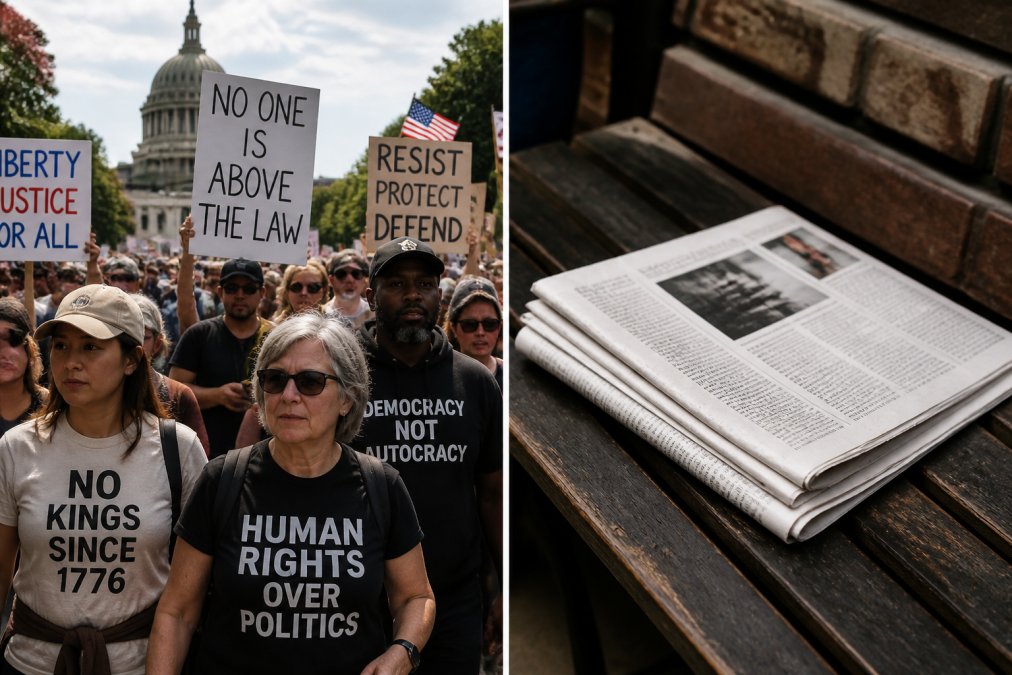
When people wear anti-authoritarian slogans on apparel, hoodies, t-shirts, caps, they're making a statement about who they are. They're signaling solidarity with others wearing the same message. In a crowd of thousands at a march, a sea of matching slogans creates what sociologists call "visual semiotics of protest", the message becomes visible from blocks away. It transforms individual belief into collective power.
The psychology here is straightforward. Humans are tribal. We want to belong. A slogan on a shirt is an invitation: belong to this group, believe this thing, act on it. When enough people accept that invitation, the slogan stops being a phrase and becomes a movement.
Examples of Pro-Democracy Slogans That Changed Discourse
Pro-democracy slogans that resonate across movements share specific qualities. They tend to be affirmative (what we're for, not just what we're against), they reference foundational values most people already hold, and they're simple enough that a child can understand them and a grandmother can remember them.
Consider slogans that have shaped political discourse: "We the People" anchors itself in the Constitution, reminding citizens of a foundational document they're supposed to own. "Hands Off" is a boundary statement, it tells power: you don't get to do this. "Democracy Now" asserts urgency: this isn't a future goal, it's a present demand.
What makes these slogans durable is that they appeal to what political philosophers call "fundamental values." They invoke rule of law, bodily autonomy, self-determination. They don't require people to adopt a new ideology. They ask people to remember what they already believed.
The best slogans also work across different movements because they're abstract enough to apply broadly but concrete enough to mean something specific. "We the People" works for labor movements, voting rights campaigns, anti-corruption efforts, and democracy defense. It's a frame that lets different groups recognize each other as part of the same larger cause.
The Psychology Behind Slogan Resonance in Protest Rhetoric
Why do certain phrases stick in your head while others vanish? Cognitive neuroscience of slogan resonance shows that memorable protest rhetoric relies on rhythm, repetition, and emotional activation. A phrase that rhymes, that repeats a sound, or that has a strong metrical beat is more likely to lodge in memory.
But memory alone isn't enough. The slogan also needs emotional weight. When a phrase connects to something you care about, your freedom, your safety, your dignity, your brain encodes it differently. It becomes part of your identity, not just information you heard once.
Protest chants work the same way. When thousands of people say the same words at the same time, the individual voice becomes part of a collective voice. That experience, speaking in unison with strangers who believe what you believe, is neurologically distinct from reading a slogan silently. It's embodied. It's social. It changes how the words feel.
Snapback Hats! VVGZUD Premium- →
This is why apparel with slogans matters. A shirt with a slogan turns the wearer into a walking chant. Every person wearing it is a node in a distributed network of the same message. That network effect amplifies the slogan's psychological impact. You see the message on others. You see others seeing it on you. The slogan becomes environmental, it's in the air.
How to Design Effective Protest Apparel With Slogans That Last
Effective protest apparel starts with a slogan that can survive repeated washing, repeated wearing, and repeated scrutiny. The message has to be legible. It has to fit the garment. And it has to stay visible long enough to do its work.
DOCVCARE THINK NOW protest apparel uses premium blanks (Gildan, Champion, Bella+Canvas) because the slogan is only as durable as the fabric beneath it. If someone wears your slogan to every march, to work, to the grocery store, it needs to look intentional, not worn out, after the third month.
The design itself matters. The slogan should be readable from 10 feet away. That means font size, contrast, and placement. White text on dark fabric works. Dark text on light fabric works. Light text on light fabric doesn't work, it disappears. The best protest apparel makes the message impossible to miss.
Consider also the garment type. A hoodie works for cooler months and offers a large canvas for the message. A t-shirt is versatile year-round and affordable enough that people can buy multiple colors. A long-sleeve shirt works for professional settings, for people who want to wear a political statement at work. A snapback cap works for outdoor events where people need sun protection anyway.
The DOCVCARE THINK NOW collection includes all these options because different people need different ways to wear their politics. Someone organizing a march might need hoodies for their chapter.
| Garment Type | Best For | Price | Durability |
|---|---|---|---|
| Unisex Garment-Dyed Heavyweight T-Shirt | Everyday wear, layering, affordability | $40 | Premium heavyweight fabric |
| Heavyweight Garment-Dyed Long-Sleeve Shirt | Work settings, professional contexts | $52 | Premium heavyweight fabric, reinforced stitching |
| Premium Champion Pullover Hoodie | Cold weather, marches, visibility | $63 | Moisture-wicking Double Dry® technology, durable construction |
| Think Now Premium Hoodie | Casual wear, comfort, everyday resistance | $68 | Cotton-blend fleece, double-stitched construction |
| Snapback Hat | Outdoor events, sun protection, visibility | $42 | 85% acrylic, 15% wool blend, adjustable fit |
Digital vs. Physical: Where Anti-Authoritarian Messages Hit Hardest
What Separates a Slogan From a Rallying Cry
Not every phrase becomes a rallying cry. Some slogans stay slogans, they're catchy, they're true, but they don't ignite collective action. Others cross a threshold and become something more: a rallying cry that mobilizes people, that becomes the verbal center of a movement.

Conclusion: Wear What You Believe
Anti-authoritarian slogans resonate because they do something politics usually can't: they make belief visible. They turn private conviction into public declaration. They transform individuals into a collective.
Shop the resistance collection and wear what you believe.
Frequently Asked Questions
What makes anti-authoritarian slogans more effective than generic protest messages?
Anti-authoritarian slogans work because they name what people are resisting, not just what they want. They appeal to fundamental values like rule of law, due process, and human dignity. A slogan that says 'protect democracy' is vague; one that says 'remove the regime' or 'defend the courts' tells people exactly what the threat is and what they're defending. This specificity creates cognitive clarity and emotional resonance.
Can you give examples of pro-democracy slogans that shaped modern movements?
Slogans like 'I can't breathe,' 'Hands up, don't shoot,' and 'The people united will never be defeated' became rallying cries because they distilled lived experience into language everyone could repeat. 'Democracy is not a spectator sport' and 'Defend the vote' became touchstones during election cycles. 'No fascism, no racism, no police brutality' names multiple threats in one breath. The strongest slogans work across demographics and stick in memory because they're short, rhythmic, and rooted in something people actually fear or believe in.
How do slogans on protest apparel differ from digital activism?
A slogan on a t-shirt or hoodie is a physical presence, it travels with you to work, school, grocery stores, and casual spaces where political speech often gets muted. It signals commitment and invites conversation. Digital slogans reach millions in seconds but disappear in feeds. Apparel is a daily choice: every time you put on a hoodie with 'remove the regime' printed on it, you're reaffirming your position. That repetition builds internal conviction and external visibility simultaneously.
What role do slogans play in organizing and building community?
Slogans create linguistic solidarity. When thousands of people chant or wear the same phrase, it erases the feeling of isolation. A person wearing a pro-democracy slogan on their shirt becomes part of a visible coalition. Organizers use slogans to unify diverse groups around a single demand or value. They're memory anchors, years later, people remember where they were when a slogan first moved them. That emotional imprint is what turns protest into sustained political participation.
