

10 Iconic Protest Signs That Changed History

Table of Contents
- Why Some Protest Signs Become History
- Quick Look: 10 Protest Signs That Defined Movements
- 1. "I AM A MAN" (1968)
- 2. "Make Love, Not War" (1960s-70s)
- 3. "Silence = Death" (1980s-90s)
- 4. "Votes for Women" (Early 1900s)
- 5. "No Justice, No Peace" (2014-Present)
- 6. "Women's Rights Are Human Rights" (1990s-Present)
- How to Make a Protest Sign That Matters
- The Evolution Toward Political Expression Apparel
- Carrying the Message Forward
- Frequently Asked Questions
Last Updated: September 8, 2026
Why Some Protest Signs Become History
A piece of cardboard, a marker, two outstretched arms. That is the entire technology of the protest sign, and yet certain signs outlive the marches they appeared in. The most iconic protest signs in history share a strange quality: they are simple enough to read in a single glance, yet layered enough to carry a movement's entire argument. They become shorthand for a demand, a grievance, or a moment when ordinary people stood up to power.
What separates a sign that gets photographed once from one that gets reprinted for decades? The answer is visual rhetoric. The best signs compress a political position into typography and spacing so effectively that the medium becomes the message. At DOCVCARE THINK NOW protest apparel, we build political-expression apparel on the principle that a slogan should say everything without needing a speech. This guide examines ten protest signs that defined movements, the historical context that gave them force, and what modern organizers can learn from their design.

Quick Look: 10 Protest Signs That Defined Movements
Protest signs are a form of visual communication that predates photography, but the ones we remember share identifiable traits: bold typography, high contrast, and an emotional hook that works at a distance. The ten signs below span more than a century of American activism, from the fight for suffrage to the modern pro-democracy movement.
| Sign | Era | Core Demand | Visual Strategy |
|---|---|---|---|
| "I AM A MAN" | 1968 | Equal treatment and dignity | All-caps, high contrast, personal declaration |
| "Make Love, Not War" | 1960s-70s | End the Vietnam War | Rhythmic wordplay, memorable antithesis |
| "Silence = Death" | 1980s-90s | AIDS awareness and action | Mathematical symbol, stark white on black |
| "Votes for Women" | Early 1900s | Women's suffrage | Direct demand, clean sans-serif lettering |
| "No Justice, No Peace" | 2014-present | Police accountability | Rhyming couplet, chant-ready cadence |
| "Women's Rights Are Human Rights" | 1990s-present | Gender equality | Broad framing, inclusive language |
Each of these signs worked because it could be chanted, printed, and carried by thousands of people at once. That scalability is the defining feature of political messaging that lasts.
1. "I AM A MAN" (1968)
The sign carried by striking sanitation workers in Memphis is a masterclass in protest sign slogans for democracy. Two thousand words of grievance, reduced to four. The phrase asserted a simple fact that the city of Memphis refused to acknowledge: that Black workers were men entitled to the same dignity and wages as anyone else.
The typography did heavy lifting. Block capital letters, white paint on black cardboard, created a stark visual impact that read clearly in news photographs and newsreels. The sign was personal and collective at once. Each worker holding it spoke as an individual, but the identical signs turned them into a unified visual force. Dr. Martin Luther King Jr. traveled to Memphis to support these workers and was assassinated there on April 4, 1968 (kinginstitute.stanford.edu). The sign became inseparable from that tragedy and the labor movement's broader fight for civil rights.
Modern organizers still borrow its structure: a first-person declaration that asserts inherent worth rather than requesting a favor. It remains one of the most reproduced protest signs in American history.
2. "Make Love, Not War" (1960s-70s)
No slogan better captures the anti-war movement's spirit of civil disobedience than this rhyming antithesis. The sign emerged from the counterculture's opposition to the Vietnam War and spread across college campuses, moratorium marches, and draft resistance actions. Its genius was turning a political position into a lifestyle choice that young people could embody.
The phrase worked as a chant, a button, and a poster because it rejected the war's logic without sounding defeated. It offered an alternative value system rooted in human connection rather than state violence. The slogan's longevity owes something to its ambiguity: it could be read as earnest pacifism, as generational rebellion, or as a critique of Cold War masculinity.
Design historians note that the sign's power came from its typographic simplicity. No ornament, no illustration, just six words arranged to maximize rhythmic impact. It demonstrated that protest art could be as disciplined as advertising, which is precisely why it spread so effectively through a media-saturated decade.
3. "Silence = Death" (1980s-90s)
Created by the Silence = Death Collective, later adopted by ACT UP, this sign used a mathematical equation to frame AIDS activism as an urgent moral reckoning. The stark white lettering on a black field, with the pink triangle inverted, drew directly from the Nazi persecution of gay men. The symbol reclaimed a badge of shame and converted it into a call to arms.
The sign's visual rhetoric was confrontational by design. It refused the polite, deferential tone that mainstream gay rights organizations had used for decades. Instead, it declared that neutrality during a public health catastrophe was complicity. The slogan appeared at the height of the AIDS crisis when the federal government's response was widely criticized as inadequate and slow.
The equation format gave the message a pseudo-logical force. It did not ask for sympathy; it stated a condition and its consequence. That structure makes it endlessly adaptable, which is why "Silence = Death" remains a template for awareness campaigns around everything from police violence to climate inaction.
4. "Votes for Women" (Early 1900s)
The suffrage movement understood that a protest sign needed to be legible in a crowd before mass media existed. "Votes for Women" achieved that with three words and a clean, direct typographic style. The slogan appeared on banners, sashes, and placards carried by suffragists who marched in Washington, New York, and London during the early 1900s.
The demand was radical for its time, and the sign's simplicity made it difficult to dismiss. It did not argue, explain, or justify. It stated a political right as a settled fact, which is precisely what made it powerful. The suffragists paired the slogan with the colors purple, white, and gold, creating a coordinated visual identity that modern political campaigns still emulate.
This sign is a reminder that the most effective protest signs often precede the legal victory they demand. The Nineteenth Amendment, ratified in 1920, came after decades of public demonstration where signs like this one normalized the idea of women voting. The phrase "Votes for Women" is preserved in the collections of the Library of Congress's suffrage materials as a record of that long campaign.
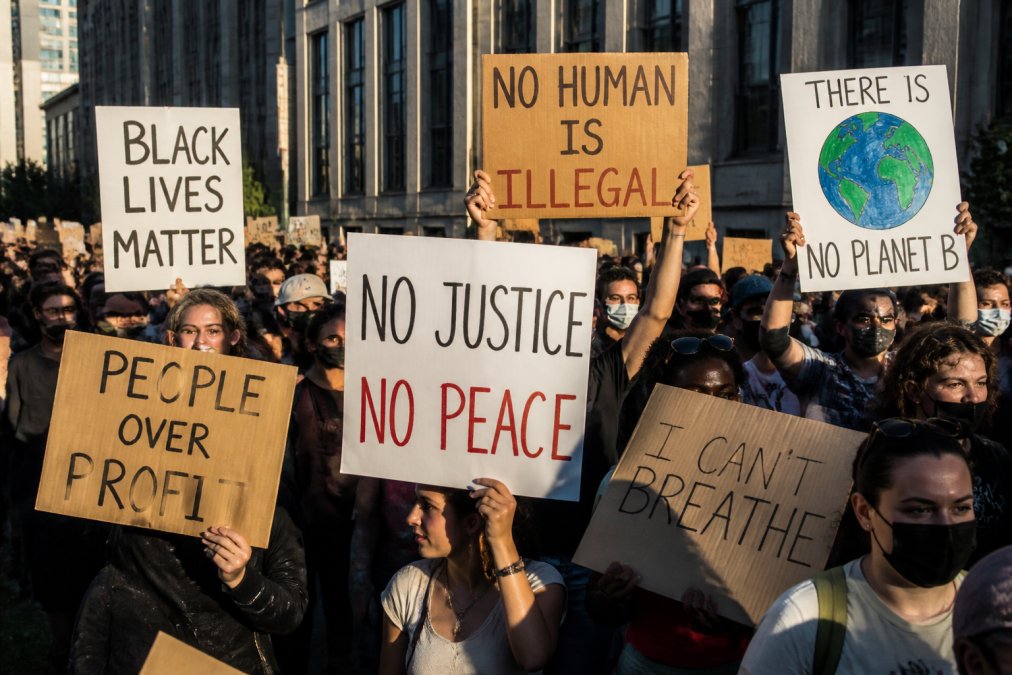
5. "No Justice, No Peace" (2014-Present)
The killing of Michael Brown in Ferguson, Missouri, in 2014 gave rise to a protest sign that has since become the default language of the movement against police violence. "No Justice, No Peace" is a rhyming couplet that functions as both a diagnosis and a warning. It asserts that a society which denies justice to some of its members cannot expect stability.
The sign's cadence makes it inherently chantable, which is why it moves so easily between placards and crowd calls. It also carries a threat, a refusal to accept the status quo, which distinguishes it from more conciliatory protest language. The phrase has been criticized by those who read it as a promise of unrest, but that is precisely its point: it names the consequence of inaction.
The sign's adaptability has proven remarkable. It appears at protests against racial injustice, economic inequality, and authoritarian overreach, always retaining its core claim that peace and justice are inseparable. For organizers, it demonstrates the value of a slogan that can be printed on a sign, shouted in a crowd, and posted online without losing meaning.
Shop the resistance collection →
6. "Women's Rights Are Human Rights" (1990s-Present)
This sign, carried prominently at the 1995 Fourth World Conference on Women in Beijing, reframed gender equality as a universal human rights issue rather than a niche concern. The phrase, associated with First Lady Hillary Rodham Clinton's speech at that conference, gave the global women's movement a unifying message that transcended national borders.
The sign's strength lies in its inclusive framing. It does not demand special treatment; it insists that women's rights belong to the same category as every other fundamental right. This rhetorical move made the message harder to dismiss as a Western imposition or a secondary priority. It connected gender justice to the broader struggle for human dignity.
The slogan has appeared at marches for reproductive rights, equal pay, and political representation for three decades. Its persistence suggests that the underlying demand remains unmet, but the sign itself has become a fixture of public demonstration, a shorthand for the claim that gender equality is not negotiable.
How to Make a Protest Sign That Matters
The history above points to a practical question for anyone heading to a march: how to make a protest sign that gets seen and remembered. The most effective protest signs follow a few consistent design principles that have held up across a century of activism.
First, use high contrast. Black text on white cardboard, or white on black, reads clearly in photographs and from across a street. Second, keep the message under eight words. A sign is a headline, not an essay. Third, use all-caps block lettering for maximum legibility. Fourth, test your sign from a distance. If you cannot read it from twenty feet away, neither can the cameras.
The emotional register matters as much as the typography. The signs that endure either assert dignity, state a demand, or name a consequence. They speak in the first person or the collective "we." They avoid abstract jargon in favor of concrete language that a passerby can grasp immediately.
The Evolution Toward Political Expression Apparel
The protest sign has a natural successor: the shirt you wear. Political expression apparel extends the logic of the sign into daily life, carrying a message into workplaces, campuses, and grocery stores where a cardboard placard would be out of place. It is the same visual rhetoric, applied to a different medium.
The movement from sign to shirt mirrors a broader shift in how activism operates. A march is a moment; clothing is a sustained statement. When you wear a slogan, you become a walking billboard for a position, inviting conversation and signaling solidarity to others who share your views. This is why political expression apparel has become a staple of grassroots movements.
The practical requirements differ from a cardboard sign. A shirt must survive the laundry, hold its print through repeated wear, and fit comfortably for long days of organizing. The message must be legible at a glance but durable enough to last as long as the garment does.
Carrying the Message Forward
The most iconic protest signs in history share a common thread: they gave people something to hold onto, literally and figuratively. They condensed complex political positions into phrases that could be carried, chanted, and reproduced. From the sanitation workers of Memphis to the global marches for women's rights, these signs prove that a well-designed message is a form of collective action.
The tradition continues. Every march produces new signs, and every sign is a bid for entry into the historical record. The ones that succeed follow the principles laid out above: simplicity, contrast, and a message that names a truth the powerful would rather ignore.
At DOCVCARE THINK NOW protest apparel, we build garments on the same principle. Our original slogan designs, printed on premium blanks from Champion and Bella+Canvas, are made to be worn at marches and everywhere else. The message survives the laundry because the resistance is not a one-day event. The Smithsonian's collection of protest objects documents how these artifacts become historical records, and our designs are created with that same intention: to say something that lasts.
The challenge for every generation is to find the words that fit the moment. The tools are simple: cardboard and marker, or a shirt and a screen printer. What matters is showing up, speaking clearly, and refusing to be silent.
The fight for democracy is won in the streets and sustained in the everyday choices of ordinary people. DOCVCARE THINK NOW protest apparel makes it possible to carry the message beyond the march, with original resistance designs printed on premium blanks that hold up wash after wash. Whether you need a hoodie for a cold morning on the picket line or a cap for a long day of voter outreach, our independent shop has the gear to keep you visible. Shop the resistance collection and wear what you believe.
Frequently Asked Questions
What makes a protest sign effective and memorable?
Effective protest signs combine three elements: brevity, clarity, and emotional impact. The best signs can be read in under three seconds, use bold typography, and connect to a shared moral value. Historical examples like "I AM A MAN" work because they state a basic truth that demands recognition. For your own sign, write the slogan, then cut half the words. If it still makes your point, it is ready.
How can I design a protest sign that carries a powerful message?
Start with a slogan that fits the specific demand of your march, then choose high-contrast colors like black on white or white on red. Use stencils or block lettering for legibility, and keep the message on one or two lines. Cardboard from a recycled box works well, but a foam board or vinyl banner holds up longer in rain. Practice holding it above your head to test readability.
How have protest signs influenced social movements?
Protest signs serve as visual communication tools that unify crowds, communicate demands to the media, and create iconic images that outlast the event itself. A single powerful sign photographed at the right moment can become a symbol for an entire movement, like "Silence = Death" did for AIDS activism. These images enter the historical record, shaping how future generations understand the struggle.
What are some famous slogans for democracy protests?
Timeless slogans for democracy protests include "Defend Democracy," "No Justice, No Peace," "This Is What Democracy Looks Like," and "Truth Matters." For current movements, direct statements like "REMOVE THE REGIME" leave no room for misinterpretation. The most effective slogans for democracy name the threat, state the demand, or affirm the principle being defended. Keep it short enough to chant.