

Made in USA Apparel: How to Spot Real American Clothing

Table of Contents
- Why Made in USA Apparel Is Worth the Hunt in 2026
- How to Identify American Made Clothing: Labels, Rules, and Red Flags
- The Raw Materials Loophole Nobody Mentions
- Union Made Clothing Brands: The Label Most Shoppers Miss
- Ethical Clothing Brands USA: What Fair Labor Actually Looks Like
- Price-Per-Wear: The Math That Beats Cheap Fast Fashion
- Care and Longevity: Making Domestic Apparel Last
- Wear the Message: Statement Apparel Built to Last
- Frequently Asked Questions
Last Updated: September 10, 2026
Why Made in USA Apparel Is Worth the Hunt in 2026
Made in USA apparel is clothing whose manufacturing happens on American soil, and finding it takes more work than reading a flag on a hangtag. This guide from DOCVCARE THINK NOW protest apparel walks through the labels, the loopholes, and the math that separates genuine domestic goods from marketing theater.
The case for buying American isn't just sentimental. Domestic manufacturing keeps skilled sewing jobs in the country, shortens supply chains that have proven fragile, and gives buyers a paper trail they can actually follow. When you wear a union-made tee to a march or a town hall, you're making two statements at once.
Below, we'll show you exactly how to verify a claim, what the law actually requires, and why the cheapest shirt is rarely the least expensive one.
How to Identify American Made Clothing: Labels, Rules, and Red Flags
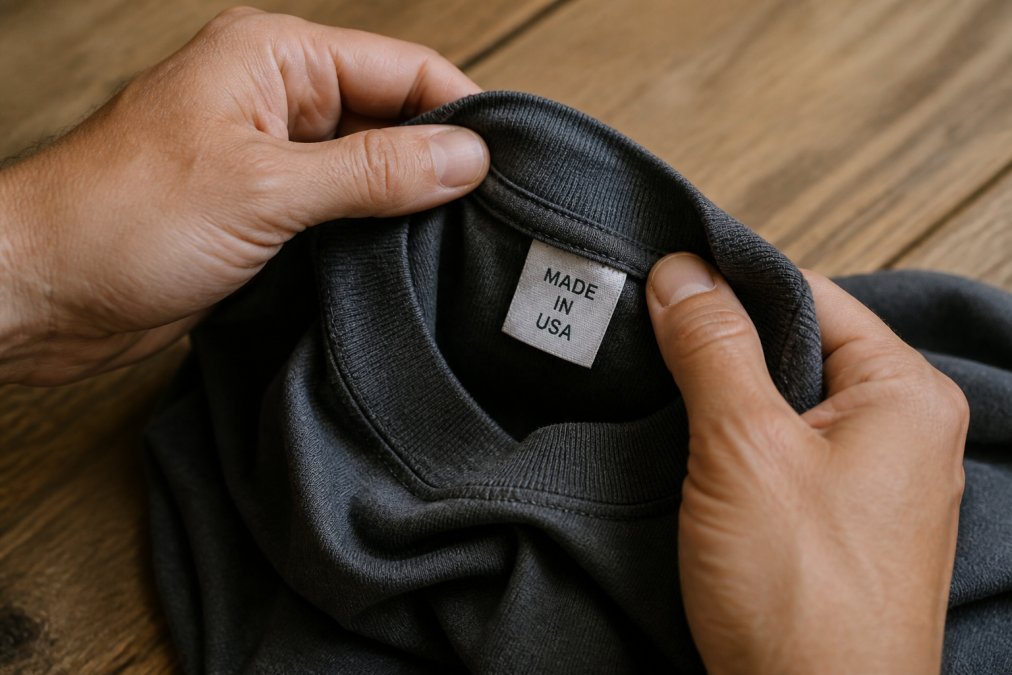
Learning how to identify American made clothing starts with one habit: turn the garment inside out and read the tag before you read the marketing.
What the FTC Actually Requires
The Federal Trade Commission sets the rules for "Made in USA" claims, and the standard is stricter than most shoppers assume. An unqualified claim requires that "all or virtually all" of the product's significant parts and processing be of domestic origin, as detailed in the FTC Made in USA labeling guidance. "Assembled in USA" is a weaker, qualified claim, and it means exactly what it says: parts came from somewhere else.
Three Questions That Expose a Fake Claim
Ask these before you buy:
- Does the label name a specific country of origin, or just say "imported"?
- Does the brand publish its factory list, or only a vague "ethically made" badge?
- Can you trace the fabric, not just the final stitch?
A brand that answers all three is worth your money. A brand that dodges them is selling a feeling, not a fact.
The Raw Materials Loophole Nobody Mentions
Here's the part most guides skip: a shirt can be cut and sewn in the country and still be made from imported cotton, imported thread, and imported dye. The FTC's "all or virtually all" standard covers significant parts, but fabric sourcing is where claims get murky.
This matters because domestic textile manufacturing has shrunk dramatically over decades, so even committed brands often import raw materials. That doesn't make the garment dishonest, but it does mean "Made in USA" describes where the labor happened, not where the cotton grew.
If full traceability is your priority, look for brands that name their mills and spinners. Few do. The ones that do are telling you something real.
Union Made Clothing Brands: The Label Most Shoppers Miss
Union made clothing brands carry a distinct mark, and it's one of the fastest ways to verify fair labor practices. The union label signals that the workers who cut and sewed the garment had negotiated wages, safety standards, and representation, and unlike a self-declared "ethical" badge, the mark is licensed to specific employers under a collective bargaining agreement (dol.gov).
Most shoppers walk right past it. That's a mistake, because a union tag is tied to an organized workforce with a contract, not to a marketing department's mood board.
The Marks Worth Knowing
- Union Made in USA, the general mark used across apparel and other goods produced under union contract.
- UNITE HERE, the union representing apparel, textile, and hospitality workers, formed by the 2004 merger of UNITE (the needle trades union) and HERE.
- International Ladies' Garment Workers' Union (ILGWU), the historic label still found on vintage garments; the ILGWU merged into UNITE in 1995, so a modern ILGWU tag means the garment is old, not newly made.
- Amalgamated Clothing and Textile Workers Union (ACTWU), another historic label, merged into UNITE in 1995.
If you see an ILGWU or ACTWU tag on something sold as new, that's a red flag about the seller, not a bonus.
How to Verify a Union Claim
A union label is licensed, not printed at will. That means you can check it:
- Look for the union's name or registered mark on the tag itself, not just on the website.
- Ask the brand which local or joint board holds the contract. A real union shop can name it.
- Cross-reference the union's own member or signatory list. Unions publish who they represent; marketing pages don't.
A brand that can't name its local is using the word "union" the way fast fashion uses "sustainable."
A union tag is a contract artifact. If the brand can't tell you which local signed it, the tag isn't doing the work you think it is.
Why This Matters Beyond the Seam
The domestic garment industry was built by organized labor, and the decline of those contracts tracks the decline of domestic manufacturing itself (bls.gov). Buying union made is one of the few consumer choices that directly funds negotiated wages and safety standards rather than a promise. When you wear that tag to a march, a picket, or a town hall, you're wearing a documented labor standard, and that's a message no slogan can fake.
Ethical Clothing Brands USA: What Fair Labor Actually Looks Like
Ethical clothing brands USA shoppers can trust share a few traits: published factory lists, named suppliers, and wages you can verify rather than assume. "Ethical" is not a regulated term, so anyone can print it on a tag.
The honest test is transparency. A brand that discloses where its garments are made, who makes them, and how workers are compensated is doing the work. A brand that offers only a vague sustainability pledge is not.
This is where supply chain transparency verification separates real actors from posers. Ask for the factory name. Ask for the audit. Brands with nothing to hide answer.
Price-Per-Wear: The Math That Beats Cheap Fast Fashion
Price-per-wear is the cost of a garment divided by the number of times you actually wear it, and it exposes how expensive cheap clothing really is. Most guides stop at that definition. Here's the part they skip: the formula only works if you count the hidden costs, replacement, care, and the time you spend re-buying.
The Formula
Price per wear = (purchase price + care costs + replacement costs) ÷ total wears
That's it. The trick is being honest about the denominator.
A Worked Example
Say you buy a discount tee and a domestic tee. Run them side by side:
| Line item | Discount tee | Domestic tee |
|---|---|---|
| Purchase price | $8 | $35 |
| Wears before it fails | 8 | 80 |
| Replacements needed over 80 wears | 10 | 1 |
| Total spent over 80 wears | $80 | $35 |
| Price per wear | $1.00 | $0.44 |
The domestic tee wins, not because it's fancy, but because you stop replacing it every season. The discount tee's sticker price is a down payment, not the bill.
The Costs Most People Forget
- Replacement trips. Ten re-buys means ten shipping fees, ten errands, ten decisions. Time is a cost.
- Care. Hot water, high heat, and heavy detergent shorten a garment's life. Cold wash and air-dry cost less per load and extend the denominator.
- Fit drift. Cheap knits stretch and pill; a well-made shirt holds its shape, so you actually wear it more.
Where the Math Breaks Down
Price-per-wear isn't a universal law. It fails when:
- You won't actually wear the item 80 times. A statement piece worn twice a year has a terrible price-per-wear no matter who made it.
- The garment needs dry cleaning. Care costs can erase the durability advantage.
- You're buying for a body that's changing. Fit beats longevity if the fit is wrong.
The honest version of this argument is: buy fewer, wear them longer, and only pay the domestic premium for pieces you'll actually reach for.
Wash domestic cotton inside out in cold water and air-dry when you can. Heat is what kills prints and breaks down fibers fastest, so skipping the dryer is the single easiest way to lower your real price per wear.
The Point
Fast fashion's low sticker price is a loan against your future wardrobe budget. The domestic premium is a bet that you'll wear the thing. Run the numbers on your own closet before you decide which bet you're making.
Care and Longevity: Making Domestic Apparel Last
Care and longevity decide whether a good purchase stays good. Even the best-made garment fails fast under hot water, high heat, and heavy detergent.
A few habits that matter:
- Turn prints inside out before washing to protect the design
- Use cold water and a gentle cycle
- Air-dry or tumble on low
- Store folded, not on wire hangers that stretch shoulders
Clothing longevity is a practice, not a purchase. Treat a well-made shirt like equipment and it will outlast three cheap replacements.
Wear the Message: Statement Apparel Built to Last
Statement apparel only works if it survives the laundry. That's the thinking behind DOCVCARE THINK NOW protest apparel, an independent, owner-run shop making political-expression clothing on premium Gildan, Champion, and Bella+Canvas blanks. Every hoodie, tee, long sleeve, and cap carries an original slogan design, including REMOVE THE REGIME, printed so the message lasts as long as the shirt does.
The garments come in unisex fits across the full range, built for long days outdoors and everyday wear alike. If you want your politics visible without saying a word, this is where the message and the material meet.
Frequently Asked Questions
How can I verify if clothing is truly made in the USA?
Check the label: the FTC requires a country-of-origin tag on most garments. Look for 'Made in USA' plus a qualified claim like 'Assembled in USA' if parts are imported. Then verify independently: search the brand's site for factory names, check the Federal Trade Commission's Made in USA guidance, and look for union labels such as UNITE HERE or Workers United. If a brand cannot name its factory, treat the claim as unverified.
Does 'Made in USA' include the sourcing of raw materials?
Not always. The FTC's 'all or virtually all' standard means the product should be made with domestic parts and labor, but many brands use imported cotton or yarn while still cutting and sewing domestically. A shirt can legally say 'Made in USA' if it is cut and sewn here, even when the fabric is imported. Ask brands directly where the raw materials come from if that matters to you.
Are there union made clothing brands I can support?
Yes. Union made clothing brands carry labels from unions such as UNITE HERE, Workers United, or the International Brotherhood of Teamsters. These labels verify that the workers who cut, sew, and finish the garment are represented by a union with negotiated wages and safety standards. Search the brand's site for a union bug or label, and check the union's own directory to confirm membership before you buy.
What are the benefits of buying American-made apparel?
Buying made in USA apparel supports domestic manufacturing jobs, keeps money in the local economy, and often means better oversight of fair labor practices and manufacturing standards. Domestic supply chains are shorter, so brands can respond faster and disclose more about working conditions. Many shoppers also find that American-made garments use durable construction and premium textiles that hold up longer, which improves price-per-wear over time.
The hunt for genuine American-made clothing takes patience, but the payoff is a wardrobe that lasts and a supply chain you can actually stand behind. DOCVCARE THINK NOW protest apparel prints original resistance slogans on premium domestic blanks, with unisex sizing across hoodies, tees, long sleeves, and caps, so your statement survives every wash and every march. Shop the resistance collection and wear the message.