

Why Sustainable Political Fashion Matters for Activists

Table of Contents
- What Is Sustainable Political Fashion and Why It Matters
- The Impact of Fast Fashion on Labor Rights
- Why Made in USA Apparel Strengthens Activist Credibility
- What Makes Ethical Protest Clothing Different
- How to Spot Greenwashing in Activist Apparel
- Digital Fashion Activism and the New Front Line
- Frequently Asked Questions
Last Updated: September 14, 2026
What Is Sustainable Political Fashion and Why It Matters
Sustainable political fashion is clothing made with ethical labor and lower environmental impact while carrying an explicit political message. It matters because what you wear to a march is itself an argument, and fast fashion undercuts that argument before you finish making it.
DOCVCARE THINK NOW exists because of that contradiction. You cannot demand dignity for workers while wearing a shirt sewn by a garment worker paid pennies in a building that fails fire code. The message and the method have to match.
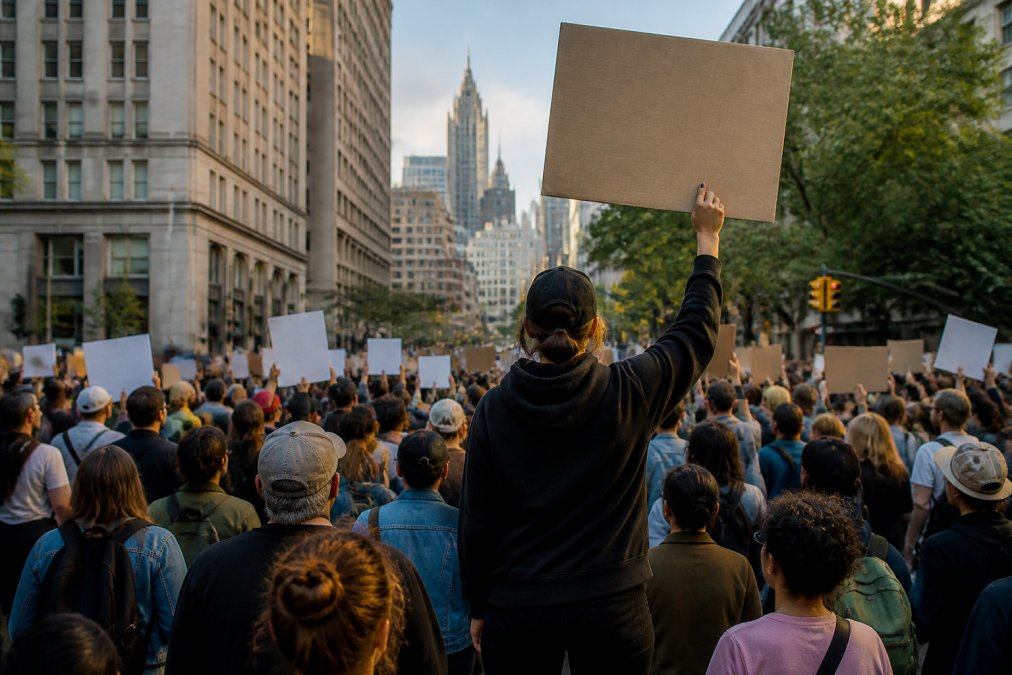
The Difference Between a Message and a Movement
A message is a slogan on a shirt. A movement is a set of commitments you keep when nobody is watching. Sustainable political fashion is the difference between the two: it asks whether the shirt itself was made under conditions you would protest.
That distinction matters more now than it did a decade ago. Fast fashion has trained shoppers to expect a new outfit for every occasion, and political merch has absorbed that habit. The result is a closet full of slogans that were made under the very conditions those slogans condemn.
Why Your Protest Gear Should Match Your Politics
Wearing a message you don't practice is the fastest way to lose an argument. Critics of any movement look for the gap between what activists say and how they live, and cheap, disposable protest gear hands them that gap for free.
The fix is not purity. It is consistency. Buy fewer pieces, wear them longer, and know where they came from.
The Impact of Fast Fashion on Labor Rights
Fast fashion depends on a supply chain designed to hide the people who make it. When brands compete on price and speed, the pressure lands on garment workers at the bottom: wages below a living standard, unpaid overtime, and factories that operate with little independent oversight. The difference between a slogan and a strategy is whether you can name the mechanism that produces that pressure, and the mechanism that could relieve it.
The U.S. Department of Labor's garment industry resources documents how global apparel supply chains concentrate production in settings where labor enforcement is weak. That is not an accident of geography. It is the business model. The department's Wage and Hour Division enforces the Fair Labor Standards Act, which sets the federal minimum wage and overtime rules for domestic garment work, and its Bureau of International Labor Affairs publishes findings on child and forced labor in apparel supply chains (Wages and the Fair Labor Standards Act). Those findings are public record, and citing them is more persuasive than repeating a brand's own sustainability page back at it.
Garment Workers and the Supply Chain You Don't See
A single shirt can pass through multiple countries before it reaches a shelf. Spinning, dyeing, cutting, sewing, and finishing are often split across subcontractors, and each layer adds distance between the buyer and the worker.
That distance is the point. It lets a brand claim ignorance when a subcontractor underpays workers or locks fire exits. Supply chain transparency is the tool that closes the gap, and it is the reason KnowTheChain's apparel benchmarking pushes companies to publish who actually makes their products.
The most documented recent case in the domestic supply chain is the garment industry in Los Angeles, where federal and state investigators have repeatedly found wage theft and unsafe conditions in sewing shops that contract for well-known brands. Those findings are on the public record through the Department of Labor and California's labor agency, and they are the clearest proof that the problem is not overseas only, it is in the same country where the march is happening.
The Policy Levers Activists Can Actually Pull
Individual buying decisions move a small fraction of the market. Policy moves all of it. The systemic fix is to make supply chain transparency and labor enforcement mandatory rather than voluntary, and there are concrete levers for that:
- Disclosure rules. Several states and the federal government have considered or adopted supply chain transparency requirements that force large apparel companies to disclose their suppliers and labor practices. Activists can track these bills, submit public comment, and press legislators to move them out of committee.
- Customs enforcement. The U.S. bans imports made with forced labor under a federal statute that lets Customs and Border Protection block shipments at the port. When the agency issues a withhold release order against a supplier, that is a documented, citable action, not a marketing claim.
- Procurement pressure. Public institutions, school districts, universities, city governments, buy enormous volumes of branded apparel. Activists can demand that public contracts require suppliers to meet wage and safety standards, which converts a consumer preference into a binding term.
- Right to organize. Domestic garment workers' ability to form a union is protected under federal labor law. Supporting organizing drives is a direct way to raise the floor at the factory level rather than the checkout counter.
None of these require a single purchase. They require showing up to a hearing, filing a comment, or voting for officials who will enforce the rules already on the books.
Why This Is a Rule-of-Law Issue
Labor enforcement is not a niche concern. It is the same question activists ask about every other abuse of power: will the rules be applied to the people who break them, or will the powerful get an exemption? A movement that treats wage theft as an unfortunate side effect of a supply chain, rather than a violation to be prosecuted, has already conceded the principle it claims to defend. The consistent position is to demand enforcement everywhere, at the port, at the factory, and at the ballot box.
Why Made in USA Apparel Strengthens Activist Credibility
Made in USA apparel strengthens activist credibility because it shortens the supply chain and puts the production under U.S. labor law. When a shirt is cut and sewn domestically, the workers who made it are covered by the same wage, safety, and organizing protections activists are demanding everywhere else.
That does not make domestic production automatically ethical. It makes it accountable. You can look up the factory, find the owner, and ask questions that are impossible to ask of an anonymous subcontractor overseas.
DOCVCARE THINK NOW prints original resistance slogans on premium blanks, including Gildan, Champion, and Bella+Canvas, so the garment holds up to repeated wear and washing. The point is not to sell you a shirt you throw away after one march. It is to give you something you can wear to the next one.
What Makes Ethical Protest Clothing Different
Ethical protest clothing is built to survive the march and the laundry that follows. It uses heavier fabrics, reinforced stitching, and blanks from suppliers with published labor and environmental standards, rather than the thinnest cotton a printer can source.
Shop the resistance collection →
The practical difference shows up fast. Cheap blanks pill, shrink, and crack at the print after a few washes. Better blanks hold their shape and keep the design legible, which matters when the design is the whole reason you bought the shirt.
Materials That Survive the March and the Laundry
Organic cotton is the starting point for most durable activist apparel. It is grown without the synthetic pesticide load of conventional cotton, and it tends to hold up better in the wash when the fabric weight is right.
For cooler marches, a mid-weight organic hoodie or sweatshirt does more work than a thin tee. DOCVCARE THINK NOW's Unisex organic sweatshirt and Unisex organic raglan sweatshirt are cut for unisex fits so chapters can order one size run for a mixed group. The Unisex Hoodie adds a kangaroo pocket and drawstring hood for long days outdoors.


| Piece | Fabric | Best For | Care Note |
|---|---|---|---|
| Unisex organic sweatshirt | Organic cotton | Cool-weather marches | Wash cold, inside out |
| Unisex organic raglan sweatshirt | 100% organic cotton | Layering, mild days | Tumble low or hang dry |
| Unisex Hoodie | Organic mid-weight cotton | Long outdoor days | Wash cold, keep print intact |
How to Spot Greenwashing in Activist Apparel
Greenwashing in activist apparel looks like a vague sustainability claim with no supply chain behind it. If a brand says "eco-friendly" but cannot name the mill, the fabric weight, or the labor standard it meets, treat the claim as marketing until proven otherwise.
Ask four questions before you buy:
- Who made the blank, and can the seller name the supplier?
- What is the fabric content, stated as a percentage?
- Does the seller publish any labor or environmental standard?
- Is the sustainability claim specific, or is it a slogan?
Performative activism often hides behind the same vague language. A shirt that says "sustainable" with no verifiable supply chain is a costume, not a commitment. Real corporate accountability means publishing the details, not just the adjective.
Digital Fashion Activism and the New Front Line
Digital fashion activism moves the same arguments into online spaces: campaign graphics, hashtag drives, and pressure campaigns aimed at brands over labor and environmental records. It reaches people who will never attend a march, and it can scale a demand for supply chain transparency in days. Most coverage of fashion activism stops at the physical garment. The gap worth claiming is what happens when the message travels faster than the shirt, and who gets heard when it does.
Intersectionality Is Not a Buzzword Here
The people most exposed to fast fashion's harms are not a single group. Garment workers are disproportionately women, immigrants, and people of color, and the same communities that absorb the environmental cost of textile production, dye pollution, microplastic shedding, landfill waste, are often the ones with the least political power to object. A fashion activism that treats sustainability as a lifestyle choice for affluent shoppers will miss the workers and neighborhoods at the center of the problem.
The practical implication is that an inclusive campaign names those connections instead of flattening them. If a chapter is organizing around a brand's labor record, it should be in conversation with the workers and community organizations already doing that work, not speaking for them. That is the difference between a campaign that borrows a cause and one that shares it.
What Digital Campaigns Actually Do Well
Online pressure works best when it is specific and verifiable. A few patterns that recur in effective campaigns:
- Targeted disclosure demands. Instead of a general "be sustainable" ask, campaigns press a named brand to publish its supplier list, factory addresses, and audit results. A specific demand is harder to ignore than a vague one.
- Receipts over rhetoric. Screenshots of a brand's own marketing next to documented labor findings are more persuasive than an opinion post, and they are shareable.
- Coordinated timing. Hashtag drives land harder when they coincide with a company's earnings call, a product launch, or a public hearing, moments when the brand is paying attention.
- Archive and follow up. A campaign that posts once and disappears is a performance. One that tracks whether the brand responded, and reports back, builds a record.
Where Digital Activism Fails
The limitation is that digital pressure is easy to perform and hard to verify. Sharing a graphic costs nothing. Showing up, organizing a chapter, and buying from makers who can prove their supply chain costs something, and that cost is what separates advocacy from a repost.
The deeper failure is when online momentum substitutes for the boring, local work that actually changes rules: attending a city council meeting on public procurement, filing a comment on a state disclosure bill, or supporting a union drive. Those actions do not trend. They do move the floor.
The Online-to-Offline Bridge
The strongest campaigns use digital reach to fill a room, not to replace it. A post that announces a hearing, a petition that converts into turnout, a hashtag that ends in a public comment, that is the bridge. The test of a digital campaign is not how many shares it got. It is whether anything changed on the record.
Frequently Asked Questions
Why is sustainable fashion considered a form of political activism?
Sustainable fashion is political because it challenges the systems that exploit garment workers and pollute communities. When you choose ethical protest clothing, you reject the fast fashion model that relies on labor exploitation and environmental damage. Your clothing becomes a statement that extends beyond the slogan printed on it. It signals that the values you march for, like human rights and corporate accountability, apply to everything you do, including what you wear.
How can clothing choices amplify a pro-democracy message?
Clothing amplifies a pro-democracy message by making it visible in everyday spaces, not just at marches. A statement hoodie worn to the grocery store, campus or workplace starts conversations that a protest sign never could. Sustainable political fashion adds another layer: when someone asks where you got it and you explain it is made in USA apparel on organic cotton, you connect democratic values to ethical consumption. The message travels further because it lives on your body all day.
What is the environmental impact of mass-produced protest gear?
Mass-produced protest gear often comes from the same supply chains as fast fashion: synthetic fabrics, energy-intensive production and textile waste after a single event. When a march ends, poorly made shirts with cracked prints get discarded, adding to landfill. Choosing durable ethical protest clothing printed on organic materials reduces that waste. The garment survives multiple marches and washes, so you buy less over time and your carbon footprint shrinks with every rewear.
Why should activists prioritize made in USA apparel?
Made in USA apparel keeps money in local economies and subjects production to US labor laws, which offer stronger worker protections than many overseas factories. It also shortens the supply chain, cutting the carbon footprint of shipping. For activists, this matters because the fight for workers' rights abroad starts with supporting ethical manufacturing at home. When you buy from an independent US-run shop, you know your money is not funding the same labor exploitation you organize against.