

7 Best Protest Slogans for Social Change in 2026

Table of Contents
- What Makes a Protest Slogan Stick
- 1. REMOVE THE REGIME
- 2. COUNT EVERY VOTE
- 3. NO ONE IS ABOVE THE LAW
- 4. POWER TO THE PEOPLE
- Impactful Protest Sign Ideas and Design Tips
- 5. DEFEND DEMOCRACY
- 6. WE THE PEOPLE MEANS ALL OF US
- 7. DISSENT IS PATRIOTIC
- How to Write a Protest Slogan That Actually Works
- Political Expression Apparel: Wearing the Message
- Where to Go From Here
- Frequently Asked Questions
Last Updated: September 12, 2026
What Makes a Protest Slogan Stick
Protest slogans compress a political demand into language a crowd can chant, a sign can carry, and a stranger can remember. This guide from DOCVCARE THINK NOW protest apparel breaks down seven slogans driving pro-democracy organizing right now, phrases that work because they're easy to say when you're tired, hoarse, and surrounded by thousands saying them with you.

Brevity, Rhythm, and Repetition
Short slogans win. A phrase that fits on a sign in thick marker and in a single breath will outlast a paragraph every time. Rhythm matters too: chants work in stressed-unstressed patterns. Repetition turns a phrase into a movement asset, the same words on signs in ten cities the same weekend become an identity.
The Psychology of Effective Messaging
Effective protest messaging names a problem, assigns responsibility, and implies an action. Phrases that only name a problem feel like complaint; phrases that point at who can fix it feel like a demand. That's why "count every vote" outperforms vague calls for fairness.
1. REMOVE THE REGIME
"Remove the regime" names the target directly and leaves no room for both-sides framing. It treats an anti-democratic power grab as what it is: a regime problem, not a policy disagreement. It's also the slogan DOCVCARE THINK NOW protest apparel built its founding design around, printed across hoodies, tees, long sleeves, and caps.

Where it lands best: large marches, sustained encampments, and anywhere the crowd already agrees on the diagnosis and needs a rallying phrase for the demand.
2. COUNT EVERY VOTE
Four words, three of them one syllable. "Count every vote" is nearly impossible to mishear and impossible to argue against in public. It reframes a procedural fight as a moral one, nobody wants to be on record saying some votes shouldn't count.
It travels well: the same phrase works on a handmade sign, a bumper sticker, a t-shirt, or a chant led from the front of a march.
3. NO ONE IS ABOVE THE LAW
This slogan does the work of a legal brief in six words: due process applies to everyone, including people who hold power. Use it when the story is about accountability, indictments, or defiance of a ruling.
Pair this slogan with a specific, documented action. "No one is above the law" plus a named court ruling is far harder to dismiss than the phrase alone.
4. POWER TO THE PEOPLE
"Power to the people" has been chanted for decades because it states the democratic premise itself: legitimate authority comes from the governed, not from whoever currently holds office. It's short, rhythmic, and scales from a dozen people on a corner to a stadium.
If you're designing for this one, go bold and simple. It reads at a distance, which is the whole point of signage.
Impactful Protest Sign Ideas and Design Tips
Impactful protest sign ideas start with one rule: legible at twenty feet, readable in three seconds. Most signs fail because they try to say too much. A sign isn't a manifesto; it's a billboard for one idea.
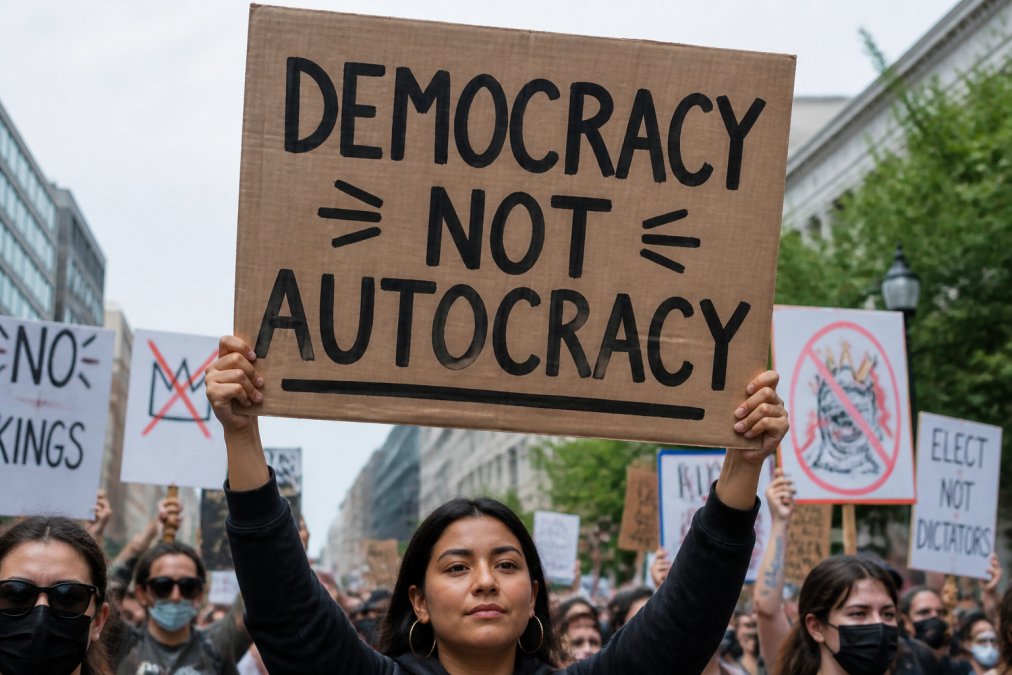
Design Decisions That Matter More Than You'd Think
- Contrast beats color. Black on white or white on black outperforms any palette. A 2023 study in Cognitive Research: Principles and Implications found high-contrast black-on-white text is read faster and more accurately at distance than colored combinations.
- Thick strokes, no serifs. Heavy sans-serif lettering survives distance and motion. Arial Black, Helvetica Bold, and Impact are reliable; script fonts and thin serifs are not.
- One message per side. Two messages means zero messages. If you must add a second line, make it a call to action ("Text VOTE to 88888"), not a second argument.
- Leave margin. Signs get cropped in photos and held at angles. A two-inch border keeps your message inside the frame.
- Skip the QR code unless you're printing large. Codes smaller than 2x2 inches are unscannable from a phone held at chest height in a crowd.
Accessibility: The Gap Most Sign Guides Skip
A sign that only works for people with 20/20 vision excludes a large share of the crowd. The CDC reports about 12 million Americans age 40 and over have vision impairment, including roughly 1 million who are blind (the CDC). A few adjustments reach more people:
- Minimum 2-inch letter height for a handheld sign, 4 inches for anything read across a street. The wayfinding rule of thumb is 1 inch of letter height per 10 feet of viewing distance.
- Contrast ratio of at least 4.5:1. Black on white is roughly 21:1; yellow on white is roughly 1.1:1, nearly unreadable to anyone with low vision or color blindness.
- Don't rely on red/green alone. About 1 in 12 men and 1 in 200 women have some form of color vision deficiency, per the National Eye Institute (nei.nih.gov). If color signals meaning, add a word or shape.
- Include a text alternative when you can. A small line of plain text at the bottom ("Image: raised fist over ballot box") makes a batch-printed sign usable in social posts and accessible to screen readers.
The Legal Boundaries of a Protest Sign
The First Amendment protects political speech, including on signs, in traditional public forums, streets, sidewalks, and public parks. But the protection isn't unlimited, and the boundaries matter before you print.
- Public sidewalks and parks. In Hague v. Committee for Industrial Organization (1939), the Supreme Court held that streets and parks have "immemorially been held in trust" for public expression. You can generally carry a sign on a public sidewalk without a permit.
- Time, place, and manner rules. Governments can regulate when, where, and how you protest, permits, noise limits, blocking traffic, if the rules are content-neutral and narrowly tailored. A city can require a permit for a march that closes a street; it cannot require one because it dislikes your message.
- Private property. Malls, parking lots, and storefronts are not public forums. The First Amendment doesn't give you a right to protest on private property, and security can lawfully ask you to leave.
- True threats and incitement. Under Brandenburg v. Ohio (1969), speech can be punished only when it is "directed to inciting or producing imminent lawless action" and likely to produce it. A slogan calling for violence against a named person isn't protected; one criticizing a public official is.
- Sign size and material rules. Some jurisdictions cap sign dimensions at demonstrations or ban rigid poles for safety. Check your city's municipal code before you build a 4x8 plywood sign on a wooden stake.
Adapting a Hashtag Into a Physical Sign
A slogan that trends online doesn't automatically work on cardboard. Hashtags are optimized for a scrolling thumb; signs for a moving crowd. Three translation rules:
- Drop the # symbol. A hashtag on a sign reads as a typo and wastes horizontal space.
- Expand the abbreviation. #NoJusticeNoPeace becomes "NO JUSTICE, NO PEACE", the comma does the rhythmic work the camel case did online.
- Add the demand the hashtag implies. A hashtag names a feeling; a sign should name an action. "#DefendDemocracy" becomes "DEFEND DEMOCRACY, COUNT EVERY VOTE."
ACLU state-by-state protest rights guides
5. DEFEND DEMOCRACY
"Defend democracy" flips the framing, casting ordinary people as protectors rather than protesters, which matters for sympathetic but hesitant audiences. It's broad enough to cover voting rights, election administration, and rule-of-law fights under one banner.
That breadth is a strength and a weakness. Use it as an umbrella slogan for coalition events, then get specific in your signs underneath it.
6. WE THE PEOPLE MEANS ALL OF US
This one borrows the Constitution's opening words and finishes the sentence the way the document implies. It's a patriotic argument, not a partisan one, and hard to counter without sounding like you're arguing "all" doesn't mean all.
It's longer than a chant, so treat it as a sign slogan rather than a call-and-response. It performs best in photographs.
7. DISSENT IS PATRIOTIC
"Dissent is patriotic" reframes the oldest smear in politics. Throughout American history, people who questioned power were called disloyal; those who were right often spoke up first. This slogan puts that history on your chest.
Shop the resistance collection →
It's the phrase I'd pick for everyday wear, it works in a grocery store, on a campus, or at a desk without a crowd around it.
How to Write a Protest Slogan That Actually Works
Writing a protest slogan is a four-step process: name the demand, cut every word that isn't load-bearing, test it out loud, then test it at distance on a sign. Most first drafts fail at step two.
A simple framework:
- Write the demand as a full sentence. "Election officials should count every valid ballot."
- Cut it to the bone. "Count every valid ballot."
- Cut once more. "Count every vote."
- Say it out loud ten times. If your throat fights it, rewrite it.
- Put it on paper and step back. If you can't read it at twenty feet, fix the lettering.
The Rhetorical Mechanics Most Slogan Guides Skip
Every set of protest slogans that has survived more than a decade uses at least one of five rhetorical devices. Knowing them lets you build a phrase on purpose instead of hoping one lands.
1. Parallelism. Two clauses with the same grammatical shape. "No justice, no peace." "Whose streets? Our streets." The second half is predictable, which is what lets a crowd join in on the first hearing.
2. Call-and-response. A leader shouts a line, the crowd answers. It's the oldest structure in protest chanting and scales best without amplification. The leader's line should be a question or setup; the crowd's answer short and identical every time.
3. Rhyme and near-rhyme. Rhyme is a memory aid, not decoration. "Hey hey, ho ho, [target] has got to go" has survived since the 1960s because the rhyme locks the second half in place. Near-rhyme ("vote" / "revolt") works almost as well and gives you more vocabulary.
4. Deixis, pointing words. "We," "here," "now," "this." A slogan that names the speaker and the moment ("We are the ones we've been waiting for") creates shared identity a third-party slogan never will. "They should count the votes" is a complaint; "Count our votes" is a demand.
5. Antithesis. Two opposed ideas in one line. "No one is above the law." "Dissent is patriotic." "They have the money, we have the people." Antithesis forces the listener to pick a side, in a protest context, that's the whole point.
A Diagnostic: Why Your Slogan Isn't Landing
If a phrase you wrote isn't catching on, run this checklist before you scrap it:
| Symptom | Likely Cause | Fix |
|---|---|---|
| Crowd mumbles the second half | Too many syllables, no rhythm | Cut to 4-6 syllables per clause |
| People ask what it means | Abstract noun, no verb | Add an action verb (count, defend, remove) |
| It reads fine but won't chant | No stressed-unstressed pattern | Rewrite in trochaic or iambic meter |
| It works in one city, not another | Too local a reference | Replace the proper noun with a category |
| It gets photographed but not repeated | Clever, not repeatable | Trade wit for rhythm |
Test It Before You Print It
Before you commit a slogan to a hundred shirts or a stack of cardboard, run three tests:
- The breath test. Say it three times without pausing for air. If you can't, it's too long.
- The stranger test. Text it to someone who wasn't in the room. If they ask what it means, it's not a slogan yet.
- The photograph test. Write it in the font you plan to use, photograph it from ten feet away. If you can't read it on your phone screen, it won't work in a crowd shot.
Political Expression Apparel: Wearing the Message
Political expression apparel turns a slogan into something you wear every day, not just on march day. A march is a few hours; a wardrobe is the rest of your life. A shirt that says "dissent is patriotic" starts conversations in line at the pharmacy that a sign never will. DOCVCARE THINK NOW protest apparel exists for exactly that gap: every hoodie, tee, long sleeve, and cap carries an original slogan design created in-house, not recycled clip art, printed on premium blanks so the message survives the laundry.
| Slogan | Best Format | Where It Works Best | Why It Lands |
|---|---|---|---|
| REMOVE THE REGIME | Hoodie, tee | Large marches, sustained actions | Names the target directly |
| COUNT EVERY VOTE | Tee, cap | Poll-adjacent rallies, canvassing | Impossible to argue against |
| NO ONE IS ABOVE THE LAW | Tee, long sleeve | Courthouse steps, hearings | Plain-language legal principle |
| POWER TO THE PEOPLE | Hoodie, cap | Coalition events, big crowds | States the democratic premise |
| DEFEND DEMOCRACY | Hoodie, tee | Umbrella coalition events | Casts citizens as protectors |
| WE THE PEOPLE MEANS ALL OF US | Tee, poster | Photo-driven actions | Borrows constitutional language |
| DISSENT IS PATRIOTIC | Cap, tee | Everyday wear, campus, work | Reframes an old smear |
If you want a statement that reads at work without shouting, a cap or single-line tee does more than a full front print. Buying for a chapter? Unisex sizing across hoodies, tees, long sleeves, and caps keeps one order simple.
Where to Go From Here
The work doesn't end when the march does. Vote in every election, including the local ones nobody covers. Show up to school board and city council meetings, that's where many decisions that affect you actually get made. Organize your block, your campus, your workplace. And wear the message, because a slogan on a shirt keeps arguing after the crowd goes home.
DOCVCARE THINK NOW protest apparel makes original slogan designs on premium Gildan, Champion, and Bella+Canvas blanks, in unisex fits across hoodies, tees, long sleeves, and caps. It's an independent, owner-run shop, not a drop-ship storefront reselling someone else's artwork.
Shop the resistance collection and put the message where people will actually see it.
Frequently Asked Questions
What makes a protest slogan effective for social change?
An effective protest slogan is short, rhythmic, and repeats a clear demand. Phrases like 'No One Is Above the Law' work because they fit on a sign, are easy to chant, and state a principle most people already agree with. Repetition across signs, shirts, and chants builds recognition, which is how a slogan moves from a single march into everyday political discourse.
How do I write a protest slogan for my own cause?
Start with the specific demand, not a general feeling. Write it in plain language, cut every word that does not carry weight, then say it out loud to check the rhythm. Aim for seven words or fewer so it fits on a sign and in a chant. Test it with a few people before you print or paint it.
What should I know legally before bringing a protest sign?
The First Amendment protects political speech, but time, place, and manner rules still apply. Many cities restrict signs with metal or wooden poles, limit size in certain zones, and require permits for large gatherings. Check your city's rules before the event, keep your sign on cardboard or foam board, and know your rights if an officer questions you.
How can I turn a slogan into political expression apparel?
Pick a slogan short enough to read across a room, then print it large and high-contrast on a tee or hoodie. Bold sans-serif type on a solid background reads best from a distance. DOCVCARE THINK NOW prints original designs like REMOVE THE REGIME on premium blanks, so the message holds up wash after wash.
How do I make my protest sign stand out in a crowd?
Use one idea per sign, big bold lettering, and strong contrast between text and background. Add a simple graphic or a pop of color if it reinforces the message. Keep the sign light enough to hold for hours, and make sure it is readable from twenty feet away.