

Table of Contents
- Why Print Quality Matters for Protest Shirts
- Screen Printing vs DTG for Activism Gear
- Best Fabric for Protest T-Shirts
- How to Care for Political Protest Shirts
- Pricing Breakdown: What to Expect for Quality Protest Shirts
- DIY vs Professional Printing: Trade-offs for Activists
- Visual Impact and Legibility: Making Your Message Heard
- Conclusion
- Frequently Asked Questions
Last Updated: September 30, 2026
Why Print Quality Matters for Protest Shirts
A protest shirt is equipment, not a souvenir. It has to survive sun, rain, a backpack, and a dozen laundry cycles, and still carry a legible message at the next march. The best print quality for protest shirts comes down to three variables: printing method, fabric, and care.
At DOCVCARE THINK NOW, we print original resistance slogans on premium blanks for exactly this reason. A cracked, faded graphic reads as an abandoned cause; a clean, high-contrast one reads as a movement that is still here. The gap between a print that lasts two washes and one that lasts two years is ink chemistry, fabric, and curing temperature.
Screen Printing vs DTG for Activism Gear
Screen printing and DTG (direct-to-garment) are two common methods for custom graphic tees, and they behave very differently under protest conditions. Screen printing pushes plastisol or water-based ink through a mesh stencil and cures it into the fabric; DTG prints a water-based inkjet layer directly onto the garment.
Durability and Ink Adhesion
Screen printing lays down a thicker ink deposit, so it resists cracking longer under washing and abrasion, with strong color fastness and a soft hand once cured.
DTG ink bonds into the cotton fibers, producing a softer hand and finer resolution, but the thinner layer fades faster on dark garments.
Cost and Customization Trade-offs
For print-on-demand sellers like us, technology makes single-piece orders viable without a minimum run. That matters for activists who want one shirt, not fifty.
Best Fabric for Protest T-Shirts
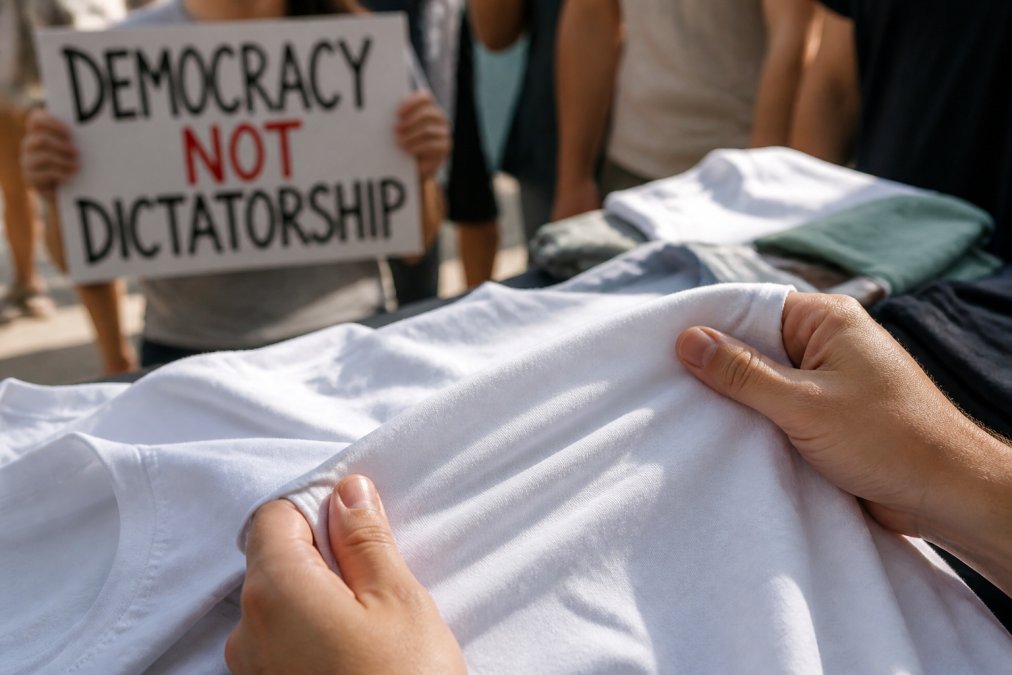
Fabric determines ink adhesion and comfort through an eight-hour march. The best fabric for protest t-shirts is 100% cotton or a high-cotton blend in the mid-to-heavyweight range, because natural fibers accept water-based and plastisol inks more reliably than synthetics.
Cotton vs Blends for Comfort and Breathability
Ring-spun cotton gives the softest surface and best ink adhesion, which is why most premium blanks use it: it breathes, wicks some moisture, and takes a print cleanly. Cotton-poly blends improve shape retention and reduce shrinkage. For a long outdoor day, a 100% cotton tee or a 90/10 cotton-poly blend is the sweet spot.
Garment Weight and Print Longevity
Garment weight, measured in ounces per square yard, matters more than most buyers realize: heavier fabric holds its shape, resists the stretching that cracks ink, and drapes better in motion.
Lightweight shirts feel cool but distort as you move, and every stretch works against the print. Midweight to heavyweight cotton keeps the graphic flat and stable, which is why our Unisex Garment-Dyed Heavyweight T-Shirt is built on a durable heavyweight cotton body sturdy enough to hold a print through years of marches.

How to Care for Political Protest Shirts
A protest shirt does not live the life of a normal tee. It gets soaked with sweat, rained on, rubbed against a backpack strap for six hours, then thrown in a laundry pile carrying sunscreen and dust. Wash cold and turn inside out is a starting point, not a plan. Here is what keeps a print alive through a season of action.
The Real Enemies: Sweat, Sunscreen, and Rain
Sweat is acidic and salty, and over time it breaks down the binder holding pigment to fabric. On plastisol it dulls the sheen; on water-based or DTG prints it accelerates fading. The fix: do not let a sweat-soaked shirt sit in a bag or hamper for days, rinse or wash it within twenty-four hours when you can. Sunscreen is the one most people miss. Oxybenzone and avobenzone, the active ingredients in most chemical sunscreens, are solvents that lift ink, especially plastisol, when a shirt is worn over a fresh layer and folded in a hot car. Apply sunscreen, let it dry fully, and consider a light undershirt between skin and print.
Rain itself is not the problem, cured water-based inks handle water fine. The problem is what rain carries.
Washing and Drying Best Practices
- Wash inside out in cold water on a gentle cycle, heat is the enemy of every ink type
- Skip fabric softener, bleach, and harsh detergents
- Do not overload the machine, friction between shirts cracks ink
- Tumble dry low or hang dry in shade, not direct sun
- Never iron directly over the graphic; press the reverse side
- Wash protest shirts separately from jeans or towels for the first several cycles
A shirt treated this way will outlast one washed hot and dried on high by a wide margin. The difference is heat, friction, and time.
Storing and Wearing Tips for Long-Lasting Prints
Fold printed shirts rather than hanging them on wire hangers, which crease and stress the ink along the shoulder line. Keep them out of direct sunlight, UV fades dye and ink alike. At a march, watch the friction points: a backpack strap grinding the same spot for hours is a quiet killer of prints.
Unisex garment-dyed heavyweight t-shirt →
What to Do When a Print Starts to Go
A print that is cracking but still legible is still doing its job. Do not retire a shirt the moment it shows wear, a faded slogan reads as history, and there is power in that. When the message becomes unreadable, replace it. Reorder from the same printer so the new batch matches, and keep the worn shirt for the next generation of the fight.
Pricing Breakdown: What to Expect for Quality Protest Shirts
Quality protest shirts generally fall in the $40 to $65 range from an independent, owner-run shop printing on premium blanks.
| Product | Price | Fabric | Best For |
|---|---|---|---|
| Unisex Classic Tee | $40.00 | 100% cotton | Warm-weather marches |
| Unisex Garment-Dyed Heavyweight T-Shirt | $40.00 | Heavyweight cotton | Long days, heavy wear |
| Unisex Sweatshirt (Air-Jet Spun) | $55.00 | Air-jet spun cotton | Cool evenings, layering |
| Unisex Garment-Dyed Sweatshirt | $60.00 | Garment-dyed cotton | Everyday statement wear |
| Oversized Heavyweight Sweatshirt | $62.00 | Premium heavyweight | Cold-weather marches |
| Champion Sweatshirt | $64.00 | Cotton blend | Durability and fit |
DIY vs Professional Printing: Trade-offs for Activists
DIY printing appeals to anyone who wants total control and low entry cost, but results are uneven.
Visual Impact and Legibility: Making Your Message Heard
A protest shirt works only if a stranger can read it from across a street, a moving car, or the back of a crowd. That is a design problem before it is a printing problem, and most guides skip it. Legibility beats decoration every time, and it is measurable.
The Mechanics of Reading at Distance
The eye resolves a letterform at distance based on three things: letter height, contrast with the background, and stroke weight. A rule of thumb from signage design is that one inch of capital letter height is readable at roughly ten feet for normal vision; two-inch letters read from about twenty feet, enough across a sidewalk, not across an intersection.
Print Method Changes What You Can Read
Not every method holds the same edge quality.
The practical takeaway: a short, bold slogan in one or two colors reads well in almost any method.
Placement, Distressing, and the Message
Placement matters as much as printing. A slogan centered on the chest at eye level is read more often than one placed low, wrapped around a seam, or split front and back. If the message is the point, put it where the eye lands first.
Designing for the Crowd, Not the Mirror
The final test is not how the shirt looks in your bathroom mirror, but how it reads in a crowd, in motion, in bad light, at an angle. A protest shirt is communication equipment, and the best print quality for protest shirts makes the message unmistakable from the moment someone sees it.
Conclusion
The best print quality for protest shirts is the kind that still reads clearly after a season of marches, washes, and wear. That means choosing the right method, the right fabric, and the right care routine, then buying from someone who takes all three seriously.
Frequently Asked Questions
What printing method is most durable for outdoor protest apparel?
For long marches and frequent wear, heavyweight cotton is a reliable choice.
How do you ensure protest shirt designs don't fade after repeated washing?
To prevent fading, wash protest shirts inside out in cold water on a gentle cycle, and avoid bleach or fabric softeners. Tumble dry on low or hang dry. Following care instructions from the maker, like those for DOCVCARE THINK NOW garments, helps maintain print resolution and color fastness.
What are the best garment materials for all-day protest comfort?
Breathable fabrics like 100% cotton or cotton-poly blends are best for all-day comfort. Ring-spun cotton offers a soft-hand feel and good airflow, while blends add durability. Heavier weights (like garment-dyed heavyweight tees) resist wind and hold prints well. Look for unisex fits that allow movement, and consider layering with a sweatshirt for cooler marches.
How does screen printing compare to direct-to-garment for protest gear?
For activism gear that needs to survive repeated wear and outdoor conditions, choosing premium blanks helps ensure durability.
The real test of a protest shirt is whether it still carries your message when it matters. DOCVCARE THINK NOW prints original resistance slogans on premium Gildan, Champion, and Bella+Canvas blanks, so the graphic holds up as long as the garment does. Every design is ours, not recycled clip art, and every order comes from an independent, owner-run shop with unisex sizing across tees, hoodies, long sleeves, and caps. Shop the resistance collection and wear the message.
