

Table of Contents
- What Makes Activist Clothing Actually Work
- Message Clarity and Visual Identity
- Durability: Print Quality and Fabric That Survives the Laundry
- Best Activist Clothing Brands Use Ethical Sourcing
- How to Style Protest Shirts for Comfort and Impact
- Choosing Ethical Protest Apparel That Reflects Your Values
- Sizing, Fit, and Accessibility for All Body Types
- Ordering for Yourself or Your Group
- Frequently Asked Questions
Last Updated: September 26, 2026
What Makes Activist Clothing Actually Work
When you choose activist clothing, you're selecting a tool for visibility, solidarity, and resistance. When you wear a statement piece to a march, protest, or around town, you're making your politics impossible to ignore. The problem: most activist apparel falls apart after a few washes, fades in the sun, or cracks at the seams. Your message deserves better.
At DOCVCARE THINK NOW protest apparel, we build garments designed to last as long as your commitment to the cause. We print original resistance slogans on premium blanks (Gildan, Champion, Bella+Canvas) so the message survives the laundry, weather, and wear. Choosing activist clothing that actually works means thinking past the design and into durability, fit, and ethics.
Message Clarity and Visual Identity
Your message has to read from across a room. If someone has to squint to understand what you're wearing, you've lost the moment. Message clarity is the first principle of effective activist apparel.
Strong activist designs are simple, bold, and unmistakable. A single powerful word or phrase beats a cluttered design every time. "REMOVE THE REGIME" works because it's direct and impossible to misread. Too many words, colors, or competing visual elements dilute your message.
Consistency builds recognition. If your group uses the same colors, fonts, or graphic style across multiple pieces, people recognize the message faster. This is why movements develop a signature look, a visual shorthand that becomes synonymous with the cause.
Legal and Safety Considerations for Your Message
Before finalizing your design, consider where you'll wear it. The First Amendment protects political speech on clothing, but context and location matter in practice.
Wear your message at lawful public gatherings, marches, and demonstrations without fear of prosecution for the speech itself. Be aware that law enforcement may photograph attendees at protests; wearing a highly visible political message means you may be identifiable. Consider whether you're comfortable with that visibility.
In workplaces, schools, or private venues, different rules apply. Employers can restrict political speech in some contexts; schools can set dress codes. Know the policies where you'll wear the piece.
Avoid designs that could be misread as threats or incitement. Courts have held that true threats and incitement to imminent lawless action are not protected speech. "VOTE THEM OUT" is protected; depictions of violence against specific people or groups are not. Stick to messages advocating policy change, voting, accountability, or political opposition, all protected forms of speech.
If organizing a group action, brief participants on what to expect. If arrest or confrontation is possible, people should know in advance and choose their participation. Context affects your safety and legal exposure.
When choosing activist clothing, ask: Can someone read this from ten feet away? Does it communicate one clear idea? Does it align with your movement? Am I comfortable with the visibility? If the answer to any is no, adjust your strategy.
Durability: Print Quality and Fabric That Survives the Laundry
Most people buy cheap screen-printed shirts and expect them to survive weeks of marching. They won't. The print cracks, the fabric pills, and the whole thing falls apart in the dryer.
Durability starts with the blank. Premium blanks use higher-quality cotton and construction that holds up to repeated washing and wear. They breathe better, feel better, and don't degrade as fast as cheap alternatives. That's the difference between a shirt that lasts one season and one that lasts years.
Print quality is equally critical. High-quality printing creates designs that stay vibrant through dozens of washes. Cheap heat transfers crack and peel; budget screen printing fades or flakes. You want a process that bonds ink to fabric, not just sits on top.
DIY Screen Printing vs. Sourcing from Established Makers
When you choose activist clothing, you face a choice: screen-print it yourself or buy from an established maker. Both have real trade-offs.
DIY Screen Printing: When It Makes Sense
DIY works for specific, time-sensitive messages, tight budgets, or small groups (under 50 pieces). You control the design, timing, and message entirely. For a one-off shirt or small batch for your organizing circle, this can work.
The catch: durability suffers without expertise. Improper screen tension, wrong ink viscosity, or inadequate curing means the print fails after a few washes. Multi-color designs are harder, and consistent quality across 20 shirts is difficult without practice.
Sourcing from Established Makers: When It's Worth It
Established makers handle technical work, offer quality guarantees, and scale from one shirt to hundreds. They have blank supplier relationships, professional equipment, and durability expertise. For group orders or when you need consistency, this is the better choice.
The trade-off: less control and higher per-unit cost. Lead times are longer and iteration is slower. But the finished product is reliable and you're not spending organizing energy on production logistics.
How to Decide
Ask: How many pieces? How soon? How important is consistency? If you need 10 shirts in two weeks and you've never screen-printed, buy from a maker. If you need 50 shirts in one week with a custom design, you need a maker.
For group actions, sourcing from an established maker is almost always right. The maker handles production quality and logistics. You focus on organizing.
Testing Durability Before You Commit
Best Activist Clothing Brands Use Ethical Sourcing
Where your apparel comes from matters. Ethical sourcing means workers were paid fairly, worked in safe conditions, and weren't exploited. Environmental impact was considered, not ignored.
Many mass-market companies hide supply chains, outsource to factories with lax labor laws, pay poverty wages, and dump textile waste. Your money flows to systems that contradict activism.
Independent, owner-run makers operate differently. They source premium blanks from transparent manufacturers, and know where every piece comes from. Ethical production costs more, but it aligns your purchase with your values.
When evaluating brands, ask: Where are blanks sourced? Who prints? Are there certifications or transparency reports? If a brand won't answer, that's a red flag.
How to Style Protest Shirts for Comfort and Impact
You'll wear this for hours, standing in the sun, walking through crowds, or sitting on pavement. Your activist clothing has to work for your body and comfort level, or you won't wear it as intended.
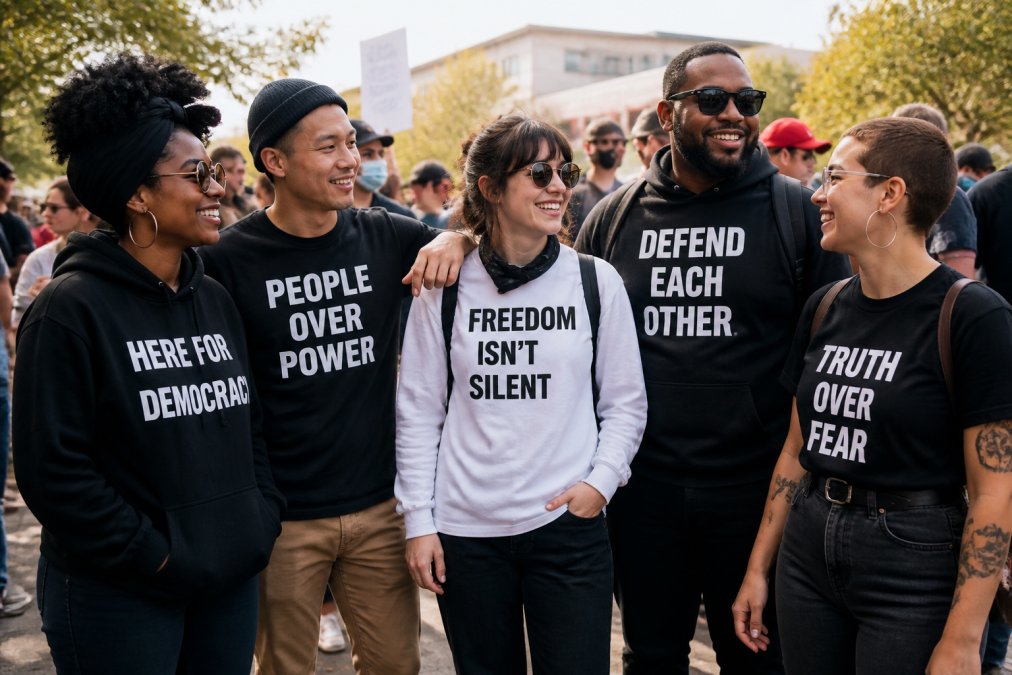
Layering is your friend. A unisex hoodie works over a t-shirt, under a jacket, or on its own. The Unisex Organic Mid-Weight Hoodie is heavy enough to stand alone in cool weather but breathable enough to layer without overheating.

Fit matters. Unisex sizing should feel comfortable on your body, not like a compromise. Too tight restricts movement; too loose disappears. The right fit means your message is visible and you can move freely.
Consider your body and conditions. For hours outdoors, moisture-wicking matters. In winter, you need insulation. For smaller frames, oversized unisex cuts may not work; look for options designed to fit multiple body types.
Accessories amplify your message. A cap with a political slogan extends impact. But keep it cohesive; too many competing messages dilute the impact.
Choosing Ethical Protest Apparel That Reflects Your Values
This is where intention meets action. Choosing ethical protest apparel means making a decision that goes beyond the design and into the entire system behind the shirt.
Start by identifying what values matter most to you. Is it fair labor practices? Environmental sustainability? Independent ownership instead of corporate mass production? Supporting a maker whose politics align with yours?
Sizing, Fit, and Accessibility for All Body Types
Unisex sizing is supposed to work for everyone. In practice, it often works for no one. A true unisex fit accommodates different body shapes, not by making everything enormous, but by designing with intention.
Ask yourself these questions when checking sizing:
- Does the brand offer XS through 3XL or larger?
- Are there actual measurements provided, not just generic size charts?
- Do reviews mention fit for different body types?
- Can you return or exchange if the fit doesn't work?
Ordering for Yourself or Your Group
Whether you're buying one shirt or a hundred, the process matters. Know what you need before you order.
Here's what to clarify before ordering for a group:
- Minimum order quantity for any group discount
- Lead time for production and delivery
- Whether customization is possible
- Return or exchange policy if sizing is wrong
- How invoicing works (one bill or split?)
- Whether the maker can ship to multiple addresses
Frequently Asked Questions
What factors should you consider when choosing activist clothing?
Start with message clarity, your design must be readable from a distance and carry a single, strong statement. Check fabric quality and print durability; activist apparel gets washed hard and worn often. Verify ethical sourcing and manufacturing practices so your purchase supports the cause, not exploitation. Finally, prioritize fit and comfort for long days outdoors. When you choose activist clothing, you're choosing a tool for political expression that needs to work as hard as you do.
How can you ensure your activist clothing aligns with ethical manufacturing?
Ask where the garment is made and who manufactures it. Independent, owner-run shops are more transparent than faceless drop-shippers. Look for brands using premium blanks from established manufacturers like Gildan, Champion, or Bella+Canvas rather than mystery overseas suppliers. Check if the company discloses its supply chain. Ethical protest apparel means your money funds resistance, not sweatshop labor.
Why is garment durability important for long-term activism?
You're going to wear activist clothing to every march, every rally, every day you want to signal your politics. That means hard washing, sun exposure, and constant wear. If the print cracks after three washes or the fabric falls apart, your message disappears and you've wasted money. Durable activist apparel, printed on quality blanks with professional methods, survives the laundry cycle after cycle, so your statement stays visible as long as you need it.
How do you choose apparel that balances comfort with a bold message?
Bold doesn't mean uncomfortable. Look for mid-weight organic cotton or sustainable blends that breathe during long outdoor hours but provide warmth in cooler months. Unisex fits work across body types without clinging or restricting movement. A hoodie with a kangaroo pocket lets you keep your hands warm and your phone secure during a march. Your activist clothing should let you focus on the cause, not on being cold or sore.
Activist clothing is a statement. It says something about who you are and what you stand for. When you choose apparel that's durable, ethically made, and designed with intention, you're making that statement count. You're not just wearing a shirt, you're wearing a commitment. Make it last.
