

What Does Good Trouble Mean in Activism? A 2026 Guide

Table of Contents
- The Roots of Good Trouble in the Civil Rights Movement
- What Does Good Trouble Mean in Activism Today?
- Examples of Civil Disobedience in History That Changed Policy
- How to Participate in Peaceful Protest Safely and Legally
- Activism Apparel and Political Expression: Wear the Message
- From the Streets to the Ballot Box: Making Good Trouble Count
- Conclusion: What Does Good Trouble Require of You
- Frequently Asked Questions
Last Updated: September 5, 2026
The Roots of Good Trouble in the Civil Rights Movement
"Good trouble" traces directly to the late Congressman John Lewis, who urged activists to get into "good trouble, necessary trouble" as a moral obligation to challenge unjust systems. But the phrase was never a vague call to rebellion. It was a precise legal and ethical framework forged in the crucible of the civil rights movement, one that distinguished between breaking an unjust law to demand change and breaking a just law for personal gain.
That distinction has a name in American jurisprudence: civil disobedience. The concept was formalized by Henry David Thoreau in his 1849 essay "Civil Disobedience," but it was the civil rights movement that turned it into a mass strategy with measurable legal consequences. The marchers on the Edmund Pettus Bridge and the students at lunch counter sit-ins were not simply protesting; they were deliberately violating segregation statutes they believed were unconstitutional, accepting arrest without retaliation, and forcing the courts to rule on the conflict between local law and federal constitutional guarantees.
The strategy worked because it was disciplined. In 1961, the Freedom Riders boarded interstate buses in the South to challenge the non-enforcement of the Supreme Court's ruling in Boynton v. Virginia, which had outlawed racial segregation in interstate transportation. Their willingness to face violent mobs and arrest without fighting back forced the Interstate Commerce Commission to issue regulations banning segregation in interstate travel facilities. Similarly, the Selma to Montgomery marches in 1965, met with the brutal violence of Bloody Sunday on March 7, created the political pressure that led Congress to pass the Voting Rights Act of 1965, signed into law by President Lyndon B. Johnson on August 6 of that year.
The legal mechanism at work is worth understanding. Civil disobedience operates on a specific theory: you violate a law you believe is unjust, you accept the legal consequences of that violation, and you use your trial and imprisonment as a platform to challenge the law's legitimacy. This is fundamentally different from rioting or vandalism, where the goal is destruction rather than dialogue with the legal system. Martin Luther King Jr. articulated this in his "Letter from Birmingham Jail" (1963), where he distinguished between just and unjust laws, citing St. Augustine and St. Thomas Aquinas to argue that "an unjust law is no law at all." King wrote that one who breaks an unjust law "openly, lovingly, and with a willingness to accept the penalty" is in fact expressing "the very highest respect for law."
This guide from DOCVCARE THINK NOW protest apparel explores what that legacy means for us today. Below, we'll show you exactly how the spirit of good trouble translates into modern activism, from the streets to the ballot box, and where the legal boundaries lie.
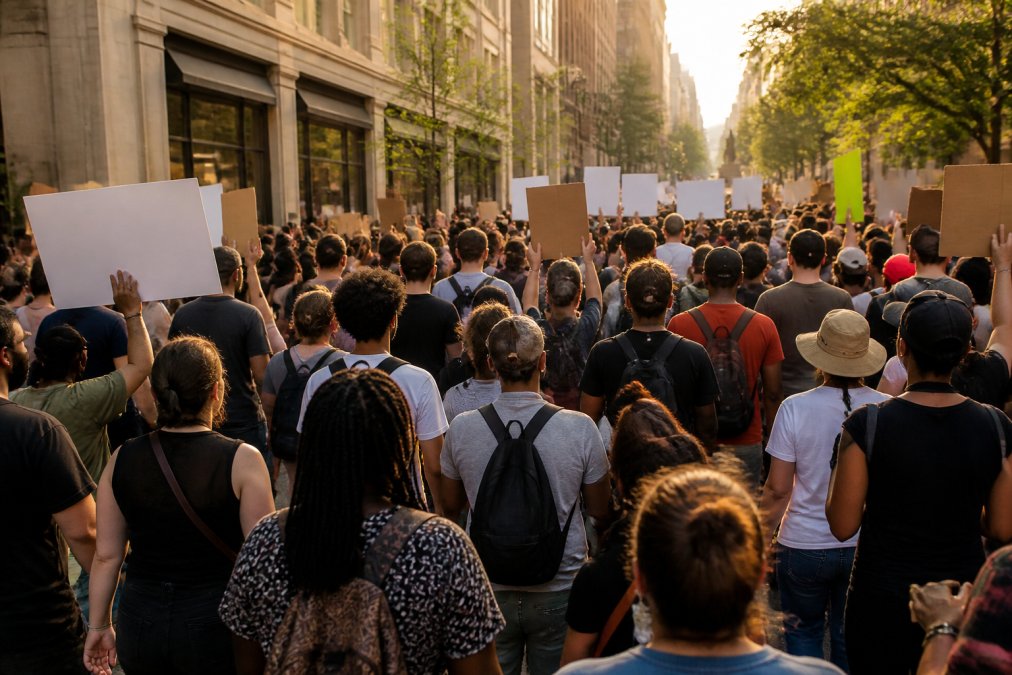
What Does Good Trouble Mean in Activism Today?
Good trouble in activism today means using your voice, your body, and your digital presence to disrupt business as usual when the system fails to protect people's rights. It is the practice of making those in power uncomfortable enough to act, while staying firmly within the boundaries of non-violent protest and civil disobedience. The goal is not destruction but transformation, forcing a confrontation with systemic injustice that polite conversation avoids.
But the definition has expanded since the 1960s. Today, good trouble operates on two distinct fronts: the physical and the digital. Both are legitimate, but they carry different risks, different legal protections, and different levels of effectiveness.
Physical Protest vs. Digital Activism: Know the Difference
Physical protest, the march, the picket line, the sit-in, remains the most powerful form of good trouble because it puts your body on the line. It is protected by the First Amendment's guarantee of peaceful assembly, but it also carries the highest risk of arrest, injury, or surveillance. When you show up in person, you are making a visible commitment that cannot be hidden behind a screen.
Digital activism, the hashtag campaign, the online petition, the coordinated email barrage, is a lower-barrier entry point that has proven effective in specific contexts. The 2017 airport protests against the travel ban, for example, were organized largely through social media and legal networks, and they succeeded in part because lawyers and citizens flooded terminals within hours of the executive order. Similarly, the 2020 racial justice protests following the murder of George Floyd saw digital organizing drive unprecedented physical turnout, with the Pew Research Center later estimating that one in ten U.S. adults attended a protest that year.
But digital activism has limits. A retweet is not a risk. A hashtag does not create the same moral pressure as a body in a street. The most effective modern movements treat digital tools as amplifiers for physical action, not replacements for it. The climate strike movement led by young activists like Greta Thunberg used social media to coordinate millions of students worldwide, but the impact came when those students left their phones and walked out of classrooms.
The Legal Boundaries of Good Trouble
Understanding what makes good trouble legal, and what crosses the line, is essential for anyone considering activism. The First Amendment protects peaceful assembly, free speech, and the right to petition the government. It does not protect violence, property destruction, or threats. The Supreme Court has consistently held that speech loses constitutional protection when it incites imminent lawless action (Brandenburg v. Ohio, 1969) or crosses into true threats (Virginia v. Black, 2003).
Civil disobedience occupies a gray zone. When you deliberately violate a law to protest it, you are committing a crime, usually a misdemeanor like trespassing or blocking traffic, and you should expect to be arrested. The legal strategy of civil disobedience is not to avoid arrest but to use the arrest as a platform. This is why organizers typically train participants in non-violent resistance and coordinate with legal observers before an action. The National Lawyers Guild and the American Civil Liberties Union both provide training and legal support for activists who plan to engage in civil disobedience.
The line between good trouble and bad trouble is not about legality alone, but about intent and method. Good trouble targets an unjust law or policy and accepts the consequences of protest tactics; bad trouble seeks to harm people or destroy property without a strategic goal. Good trouble is transparent and aims to educate the public, while bad trouble often alienates potential allies and hands opponents an excuse to crack down.
A practical test: does your action protect or advance human rights, or does it endanger others? If the action requires secrecy to avoid accountability for violence, it is not good trouble. If you are willing to state your name and your cause openly, you are likely on the right side of that line.
Examples of Civil Disobedience in History That Changed Policy
History provides clear examples of civil disobedience in history that delivered measurable reform. The Montgomery Bus Boycott, the Freedom Rides, and the Selma to Montgomery marches all used peaceful assembly to expose brutality and force legislative change. These movements understood that the moral high ground was a strategic asset, not just a philosophical one.
Shop the resistance collection →
More recent examples of civil disobedience in history include the 2017 airport protests against the travel ban, where lawyers and citizens flooded terminals to challenge the policy, and the Dakota Access Pipeline protests at Standing Rock, which centered Indigenous water rights. In each case, the disruption was aimed at a specific policy or action, and the protesters explicitly framed their resistance as an appeal to higher law and human rights. The public record shows these tactics forced courts and legislatures to respond, proving that social change rarely happens without grassroots organizing.
How to Participate in Peaceful Protest Safely and Legally
Participating in peaceful protest requires preparation that goes beyond showing up with a sign. First, connect with the organizers to understand the route, the demands, and the plan for de-escalation. Second, travel with a buddy and write emergency contact numbers on your arm in permanent marker in case your phone is confiscated. Third, leave illegal items at home and expect that anything you carry can be searched if you are detained.
A common mistake is assuming that all protests are treated equally under the law. While the First Amendment protects peaceful assembly, local ordinances often require permits for marches that block traffic, and failure to comply can lead to arrests that distract from the message. The American Civil Liberties Union guidance on protest rights provides a detailed breakdown of what officers can and cannot do during a demonstration, which is essential reading before you go.
Know Your Rights Before You March
Before you march, memorize a few core rights. You have the right to record police officers in public spaces, the right to remain silent, and the right to an attorney if arrested. You do not have to consent to a search of your phone or your bag, though officers may search you incident to an arrest.
Activism Apparel and Political Expression: Wear the Message
Activism apparel and political expression turn a crowd into a chorus. When hundreds of people wear a unified slogan, the message becomes visible from blocks away, and it signals to fellow supporters that they are not alone. For the wearer, a statement shirt is a low-barrier entry point into activism, a way to declare your position in line at the grocery store or on the train without needing to give a speech.
This is where DOCVCARE THINK NOW protest apparel comes in. Rather than settling for recycled marketplace clip art, the line offers original resistance slogan designs printed on premium Gildan, Champion, and Bella+Canvas blanks. The point is durability: a message that survives the laundry and the long hours of a march. When you wear a design like REMOVE THE REGIME, you are signaling that your commitment is not a costume for one afternoon but a sustained position. Other providers may offer cheaper prints, but they often crack after a few washes, which undercuts the permanence of the statement you are trying to make.
If you are organizing a chapter or a group, matching shirts build cohesion and make your presence read as organized and serious to the media and to officials. The unisex fits across hoodies, tees, long sleeves, and caps are designed to work for a range of body types, so your whole crew can participate comfortably.
From the Streets to the Ballot Box: Making Good Trouble Count
Street pressure and electoral power are two halves of the same strategy. Protests set the agenda and shift public opinion, but voting locks in the policy changes that protect human rights and the rule of law. The civil rights movement understood this, which is why the fight for voting rights was so central to it. Demonstrations without elections are a pressure valve; elections without demonstrations can become complacent.
To make your good trouble count beyond the march, register to vote and verify your registration status before the deadline. Show up for primaries, not just general elections, because those often decide the actual race in many districts. Then, hold your elected officials accountable between cycles by calling their offices and showing up to town halls. The Brennan Center for Justice research on voter turnout confirms that consistent voting habits are the strongest predictor of civic engagement, and the Library of Congress records on the Voting Rights Act document how hard-won those protections were.
Conclusion: What Does Good Trouble Require of You
What does good trouble mean in activism if not a personal call to step off the sidelines? It requires you to be uncomfortable, to risk social friction, and to show up consistently even when the cameras leave. It asks you to study the issues, know your rights, and act with discipline so that your disruption cannot be dismissed as lawlessness.
The challenge is to make good trouble a habit, not a headline. Wear the message to work, to the march, and to the polling station. Organize your block, your chapter, and your friend group. When you need gear that holds up to the fight, the independent, owner-run DOCVCARE THINK NOW protest apparel shop prints original designs on premium blanks built to last. Get started with DOCVCARE THINK NOW protest apparel and make your message part of the movement.
Frequently Asked Questions
Who coined the phrase 'good trouble'?
The late Congressman John Lewis popularized the phrase. He urged people to 'get in good trouble, necessary trouble' while speaking about the civil rights movement and the ongoing fight for voting rights. Lewis himself was arrested more than 40 times during non-violent protests, and he used the phrase to encourage a new generation to challenge systemic injustice through peaceful assembly and civic engagement.
What is the difference between civil disobedience and an illegal act?
Civil disobedience is a deliberate, public, and non-violent violation of a specific law to protest an injustice. Practitioners accept the legal consequences, which is what gives the act its moral authority. An illegal act for personal gain or with intent to harm others is different. Good trouble is always non-violent, transparent about its goals, and rooted in a moral obligation to challenge an unjust policy.
How can I participate in a peaceful protest for the first time?
Start by going with an organized group or an experienced friend. Know the route and the organizer's stated demands. Bring water, snacks, and your ID, and keep your phone charged. Memorize the ACLU's protest rights card or have the number of a legal observer handy. Dress for the weather and wear comfortable shoes. If you do not want to march, you can still support by providing water, first aid, or ride coordination.
Can wearing political apparel actually make a difference?
Yes. Activism apparel and political expression serve as a visible signal of solidarity and a conversation starter. When a crowd wears matching slogans, it builds group cohesion and shows the strength of the movement to the public and the press. For the wearer, it is a daily reminder of their civic duty. Choose quality garments printed on premium blanks so the message survives repeated wear and washing.
This article was written using GrandRanker